
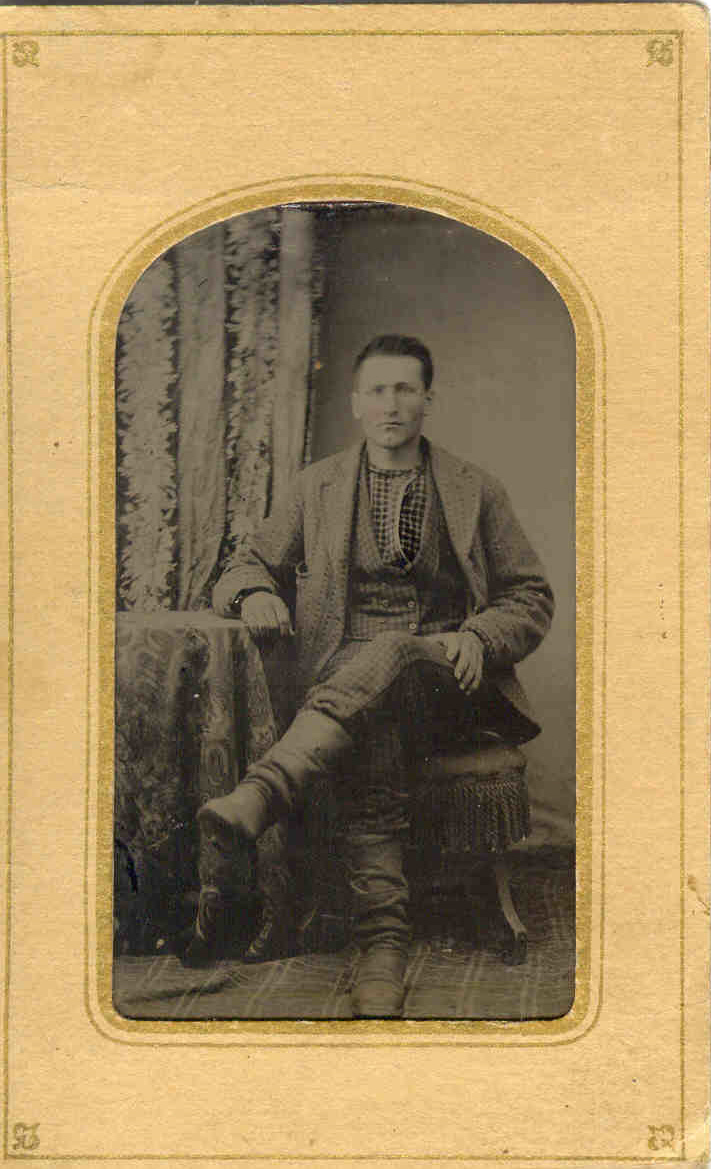
Peter Levoy, my great-great-grandfather was born on June 22, 1853 in McNab Township, near Aylmer, Quebec (Canada). The 6th child in a family of 10 children, Peter was the eldest son to Achan and Mary Ann Lavoy. Although family historians claim that Mary Ann did not allow French to be spoken in the house, censuses show that French was Peter’s mother tongue and that he spoke, read and wrote English fluently.
My first official record of Peter is his marriage record. On the 19th of September 1871 he married Agnes Stewart of the well-known large Stewart family in McNab township. The record gives a picture of the Leavoy family. Peter, age 19, was working as a laborer- likely alongside his father. Agnes was only 17. Her parents’ names are given: John Stewart & Mary Ann Smith. Peter’s parents are listed as Edward Lavoy (the spelling of his name is never consistent) and Mary Ann Mackie. The couple married at the Presbyterian church in Renfrew, and were witnessed by James Story (from McNab) and Margaret McLean (from Arnprior).
The 1871 census of McNab, which was taken just before the couple were married, shows that the Leavoys and the Stewarts were living nearby one another (13 houses apart) and that Peter and Agnes were still living with their families. While Peter laboured, Agnes worked as a servant. Her father is also listed as a laborer and may have known Achan and Peter from work.

Taken from the Rand & McNally Co. Map of Ontario (1890), I’ve highlighted towns where Peter lived
By the time the federal census of 1881 was taken, Peter and Agnes had been married for 10 years and on that document they have four children: John (7), Peter jr. (5), Elizabeth (4) & Mary (1). Peter is still laboring at this time. He continued to work as a lumberman and laborer in the Renfrew area and his name crops up in the county farmer & business directory. It shows the location of his farm: Lot 1, Concession K in Braeside next to his father’s farm (1888) and then at Lot 5, Concession 7 in Horton (1891). He seems to have followed his father’s path- farming half of the year and laboring during the other half in lumber camps.
There was another federal census in 1891 which shows that he was living in the very rural settlement of Horton (outside of Renfrew) and had 8 children: John (17), Peter jr.(15), Elizabeth (14), Mary Ann (11), Emma (9), James (7), Gordon (my great-grandfather, 4) & Stewart (1). Everyone but the two youngest children, of course, could read and write in English.

By 1894 the local business directory reveals that Peter moved again with his family- this time to Alice Township, Pembroke at Concession 14, Lot 21 where he continued to farm, now alongside his sons James and John for six months of the year.

The 1901 census shows Peter and his son John made $1.50 in extra earnings during the year from farming, while Gordon (14), Stewart (11) and Mable (8) attended school 8 months of the year. The family had burgeoned to 11 children with the addition of Mable and two other daughters- Carrie (6) and Violet (4).
Some time in the next 10 years, Peter moved much further out to Collingwood, north of Simcoe. His parents had died, and it appears that he had decided to try his hand at different work. The 1911 census reveals Peter’s new employment as a carpenter at the Shipyard where many of his neighbours were also working.

Incidentally, Collingwood Dry Dock Shipbuilding and Foundry Company was Collingwood’s largest employer at the time and at one point employed 10%of the labourers in town. It created the first steel-hulled ship launched in Canada and contributed to the production of boats for the navy during World War 2. Peter would have moved his family some time between 1902-1910 as he is listed in the 1901 census as still living in Renfrew. The Collingwood Museum website states that:
[…]1900 was a turning point in the Shipyard at Collingwood. It was decided by management to turn to brand new technology, as other shipyards had done, and begin building ships of steel. This had a huge impact not only on the workers of the yard, whose trades had changed dramatically, but also on the entire community, as the Shipyard no longer needed local lumber mills and began to have steel brought in by rail. (Hulls of Hurontario: Collingwood’s Maritime Legacy)
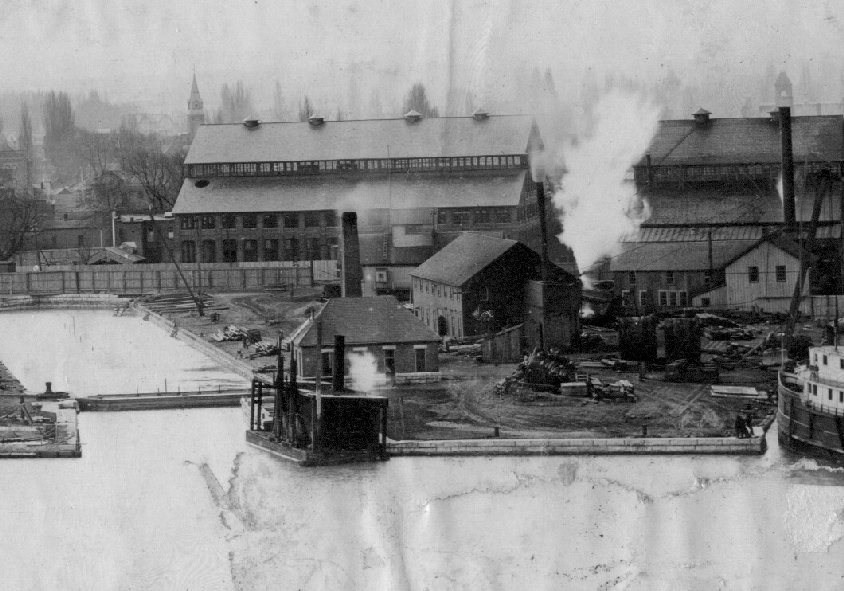
Here is the shipyard where Peter Lavoy worked in 1911. “To the left is the second dry dock, built 1903. The new dry dock allowed repair and refit work to be carried out while the launch basin and dry dock to the west was still in use.
I was curious as to why Peter would move from Renfrew, Ontario and his dairy farm (as it has been described by family members) south to Collingwood to take up Carpentry. It seems that the shipping industry was booming, so one can assume that if the dairy farm was not lucrative enough to supplement his labour, this might have been a better option. However, the odd fact is that he is listed as a Carpenter. He must have been involved in ship repair as opposed to ship building as the company management had decided 10 years prior to begin building steel ships. This line of work does recall the story of Achan’s trip to Canada and skill as a carpenter on the ship.
Peter was getting up in years (age 55) and most of his children were adults and were no longer living at home. In 1911 he was living with his wife, Agnes, and his two teenaged daughters, Mabel and Agnes B. It is likely that the move to Collingwood was a form of downsizing or to follow more stable employment. Yet in this new line of work his wages were relatively low in comparison to many of his neighbours who also worked in the shipyard (he earned $195 in the last year while his neighbours earned closer to $300 or $400). It appears that he was just scraping by working 59 hour weeks and making little money.
A final fact on this census that leads me to speculation is the spelling of his name on the 1911 census and the recording of his background and his province of birth. In all previous censuses, Peter is listed as having a French background (although his mother was Irish) and has stated that French was his mother tongue. He is always listed as being born in the province of Quebec. Here in Collingwood, his name is spelled Levi as opposed to Lavoy. He is listed as Irish as opposed to French-Canadian. His province of birth is listed as Ontario. I do know that this character is him and not another man, as the name of his wife and two youngest daughters correspond, as do their ages. Looking at his neighbours on the census, most are listed as English, Irish and Scotch and their sunames correspond. I wonder if Peter was attempting to blend into his English community and lose his French background?
At the end of this story I have no death date or place of burial, so Peter’s end remains a mystery. Some researchers claim that he is buried in Purdy, Ontario with his father. I have yet to find evidence of this and it appears to be yet another aspect of the story that requires local research..

 Oh What a Tree
May 8th, 2011 at 8:50 am
carlow cemetery where the lavoys a buried is at the white church at boulter ont and is in hastings county. my grand father edward andrew (ned) grandson of achan told me jim mackey achans father in-law was a ships carpenter. i have a caulking iron that came down through the family. there was also a ship builders adze but the where abouts are unknown at this time.
January 11th, 2012 at 6:35 pm
Carpenters in the shipyard would likely have worked on the interior of the ships – putting up walls, building cabinets and furniture etc., for the cabins. They could also work on the wooden framework used to launch the ships. my father did this during the 60’s and 70’s.
February 10th, 2025 at 11:34 am
Thank you for clarifying this, Ruthanne.
April 9th, 2017 at 1:46 pm
my grandmother was mabel there was 11 children i only met the girls who where very close the eldest was Emma
From what i know there mother died. Mabel married Peter roy Mcmillan who died in the first world war If anyone is interested please contact
February 10th, 2025 at 11:19 am
Wow – you’re a cousin! Thank you for connecting and filling in some gaps, Brian!