Tag Archives: family history

What About All Those Other Leavoys?…A look at William Henry Lavoy

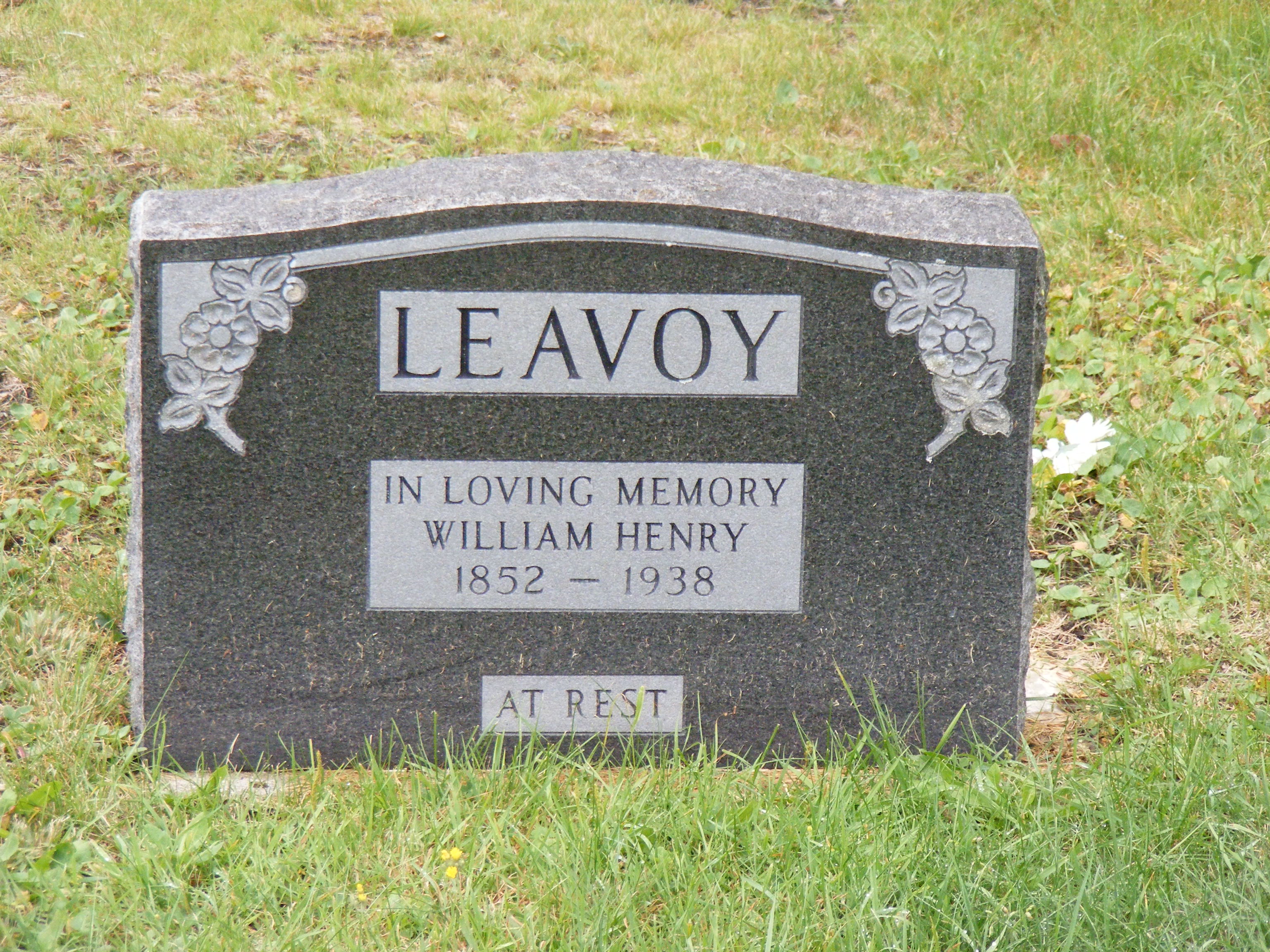
William Henry Leavoy. Photo courtesy of Jim Smith.

There is much information collected on William, the second son of Achan and Mary. In fact, before I ever really uncovered the story of his brother Peter, who is my great x 2 grandfather, I found stories, census records and family members all talking about William. This is largely due to the fact that he was written about extensively by his grandson, Wilfred Ronald Leavoy in an autobiography, and consequently this is where much of the meat of my story is gathered from. To read from this primary source beyond the quotes I give, click here. The research that informs this story is largely census-based, and is supplemented by family stories and photographs submitted by readers of this blog. A big thank you to these other Leavoys!

William’s story begins on September 5, 1854. The seventh child and middle son of the family seemed to be well received and was considered by others as “handsome[…] a noted singer, dancer and river dancer.”(Robin Murphy)  These characterizations come from his years as a young man, but even as a child he was special. It is claimed by his grandson that he was the first white boy to be born in the village of Pontiac, Quebec.
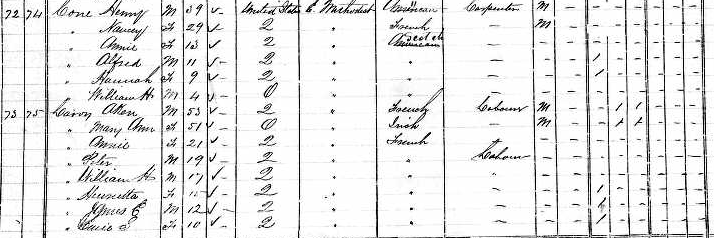
At age 17, the 1871 census of Canada has captured a picture of William’s youth and what it might have been like. In the McNab district of South Renfrew, the family of seven children lived with parents “Aken” and Mary, and sister Mary Jane‘s husband with their 2-month-old baby, Mary Ann.  This was a multi-generational home built on lumbering in the dark months and farming in the summer. Peter, two years William’s senior, is listed as a labourer, but William neither attends school or works…at least not on paper. Yet we know from family stories that William followed his father in the logging camps and was likely out in the bush as soon as he could drive horses and had left school. His grandson has noted that “[h]is family had very little schooling, with a large family on a farm; they had to dig in to help feed the rest.” This means that all of the boys in particular would have entered the workforce early. He would have worked hard, indeed, moving up in the ranks with his talent and brawn so that as a young man he was in some position of authority. W. R. Leavoy described it thus:

[m]y Grandfather followed the logging and as a young man became a foreman which meant you were like a Captain on a ship. When you went into the woods in the fall you took your men, horses and supplies to last five months and in most cases when the snow got deep you were pretty well isolated. You had to be able to lick any man in the camp as you couldn’t call the cops. There were none. No phones and no radio either. You were there till the ice went out then the men drove the logs down the rivers to the sawmills. It was a terrible job, wet and cold and quite a few graves lined the river banks as the logs would get caught and pile up in the narrow places along the river. Then you have a logjam. They would have to pry the key logs out and sometimes the whole thing would let go suddenly, crippling some and drowning some.

From this character-filled story we can see that the Leavoy boys, William included, needed to be smart working in these dangerous conditions.

I have found William at age 25 on a voters list living further south along Lake Ontario, in Colbourne. He would have been married at this time and trying to make a fresh life of his own. The voter’s list gives his place of residence as Lot 6 concession 5. But by age 26, only a year later, William was already a widower. His little recorded first marriage to a woman named Janet McWhirter ended with her premature death at age 25. She was buried in the Carlow United Church cemetery with her family. One Leavoy family member has noted that this couple had 2 children together: Eva Maude Leavoy (born April 8, 1883) and Mary Anne Leavoy (born 23 July 1884). If you have more information on this first marriage, do comment at the end of this blog entry!

Janet Hamilton Hynes. Photo courtesy of Jim Smith.

His second marriage came a year later, to Janet Hamilton Hynes  (24), daughter of another farming couple, William and Ellen (Tefler) Hines. On his marriage certificate he is listed as a widower, confirming that his first wife, Janet McWhirter, had in fact died. His parents are listed as “Stephen” (another curious spelling!) and Mary Ann. The witnesses were Thomas & Jessie Stewart were of the nearby prominent Stewart family and may have been relations to sister-in-law Agnes (Stewart) Lavoy.

This couple had fourteen children together between 1883 and 1908. The first two children died as infants (the 12 surviving children were: William A., Teresa, Ellen J., James H., Geneve, Ernest W., Wilfred Garnet, Hannah, Abbott Raymond, Iva E., Kenneth P., Maurice) and one can imagine that the first few years of their marriage would have been difficult in light of this. It isn’t surprising to see that the couple was documented as being particularly religious  on the following census.

The first census document to list William and his second marriage is that of 1891. Living on a farm in Hastings North, they have five children and subscribe to the religion Plymouth Brethren, a conservative evangelical Christian movement of their time. Children William Henry Jr. (born December 31, 1885), Tressa Mabel (born 23 February 1887), Elleanor “Ellie” Irene (born 11 March 1888), James Herbert (born 11 April 1889) and Genevieve Gertrude (born 17 October 1890) would have been supported by their father’s farming and would be raised in a community of farmers from all kinds of European countries.

Ten years later the Leavoy clan still resided in the North Hastings area, but had grown considerably as would be expected of a farming family. The couple now lived with their eleven children ranging from infancy to mid teens. Eldest son, William jr.(15) attends school for 4 months a year, and likely helped his father, uncle James and grandfather Achan who were now all neighbours. Teresa (14) and Ellen (13) also attend school for 4 months. Younger brother James (11) only attends for 1 month and Genevieve (10) doesn’t go at all.
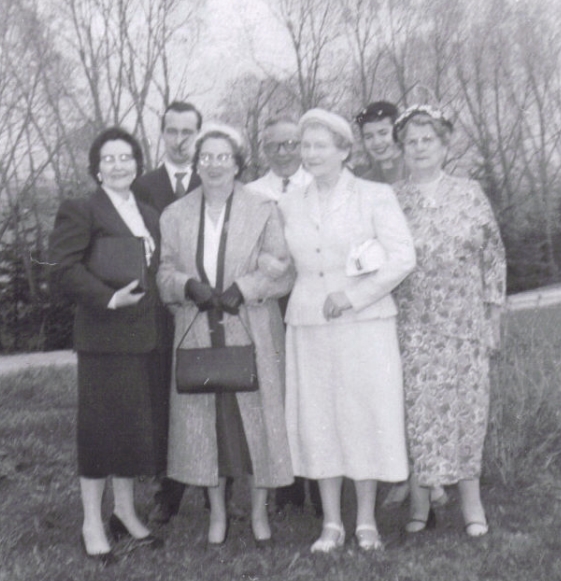
   

The Leavoy sisters in 1956. In the front row are (left-right): Pearl (Leavoy) Hazlett, Iva (Leavoy) Burwash, Tressa (Leavoy) Gates, Ellie (Leavoy) Henderson. Photo courtesy of Garnet Leavoy.
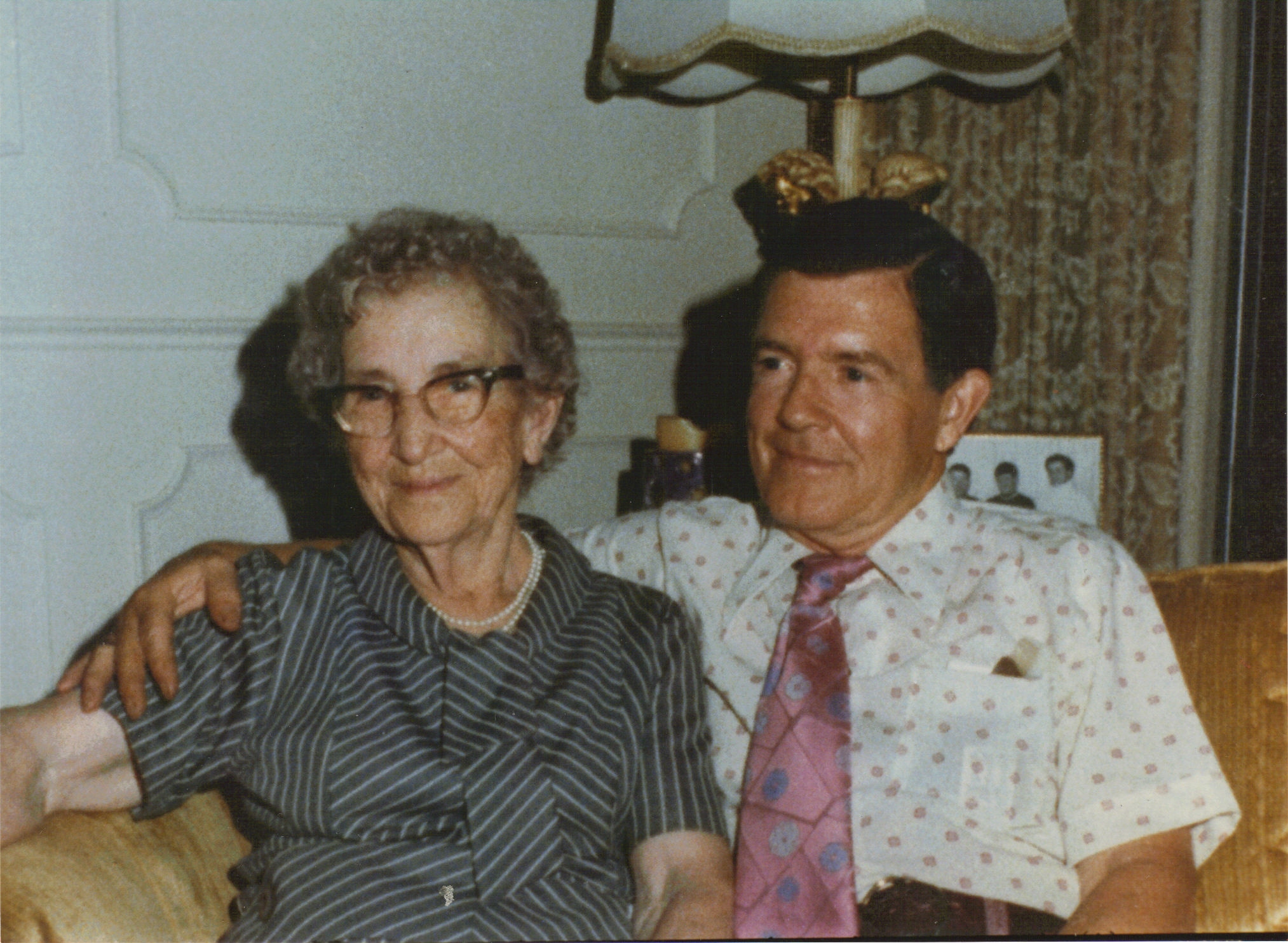
Hanna (Leavoy) Price and son, Norman. Photo courtesy of Garnet Leavoy.

Daughter Genevieve Gertrude Leavoy. Photo courtesy of Garnet Leavoy.

Added to their roost are children: Ernest Wellington (born 17 June 1892), Wilfred Garnet (born 9 July 1894), Hannah Effie (born 15 September 1895), Edward/Abbott Raymond ( born 1 March 1897), Iva Emily (born  22 May 1899) and Harriet “Pearl”. (born 9 July 1901). The last child to be born to the couple, who had not yet arrived, was a son called Maurice Reynold (born 10 February, 1908).
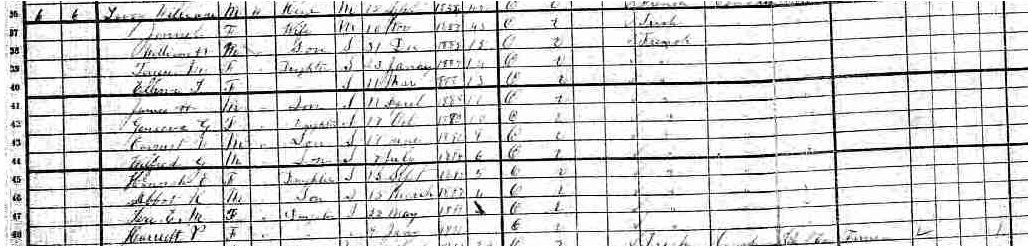
In 1911, William and Jannet were recorded in south Renfrew with the spelling of their last name as Lavoi. William’s father Achan died in 1902, signalling a change in living arrangements: they were no longer neighbours. In their 50s, they still supported a family with young children, but now had one of their eldest daughters and their son in law living with them. Their children Wellington (this is “Ernest W.” from the previous census, now 18) and Garnet (“Wilfred” from the previous census, now 16) both worked on their family farm at Lot 5. Daughters Hannah (15), Edith (Iva from the previous census), Pearl and Maurice all still live at home. The dates given for their births in this census conflict with those of the census 10 years prior, making their exact ages difficult to decipher. Another change that this document gives evidence of is the marriage of their second daughter “Ella” or Ellen (age 22).  She and her husband John Henderson (25), moved in with the Lavoy family,  likely giving help with expenses as John works as a machinist in nearby Coxandum mine, earning $750 in a year.

Cross-referencing this census information with the autobiography of William’s grandson gives further insight into these living arrangements.  He notes that two years prior to this census date, gold had been discovered in nearby Porcupine Creek and heavily forested and rough farm land was being offered in the Mattheson area for a cheap price of 50 cents per acre.  Interestingly, Mattheson has since been known for its gold. The Lavoy family moved into the area, scooping up four farms: one for William Sr., William Jr. and his new wife Annie Mae (McPherson), one for son Raymond, and another for Ella and John Henderson. They settled in the area along the railroad in Mattheson in 1913, according to W.R. Leavoy.  Unfortunately, in 1916, much of the town burned down and William Jr.’s two homes were lost in the great fire.

After this census, none other are publicly available. We are lucky, however to have family members willing to share photos, details and stories of their own. We also have a great storyteller in the family who has written from personal experience, Wilfred Ronald Leavoy, a man whose story is worth reading for those who are interested in the greater details of this family’s story.

Janet (Hamilton) Leavoy funeral, July 6, 1922. Pictured in this image are the following (left-right): sons Maurice, William H. jr. and Wellington, husband William Henry Leavoy Sr., sons Raymond H. and Garnet. Photo courtesy of Garnet Leavoy.
photograph courtesy of Garnet Leavoy

Suffice to say that in 1922 William’s wife Jannet died and he later followed in 1938, after continuing to farm with the help of his grandchildren. This family, as many of the others in the Leavoy clan, had a great impact on the Canadian landscape. They participated in the ‘taming of the land’ from Quebec to Lake Ontario and left their mark in the farm fields, forests and mines. The couple is buried in Carlow cemetery, in the Ottawa valley, Ontario (Canada).

What About All Those Other Lavoys?…Mary Jane Hogg

I’ve taken a hiatus from my research for a few weeks to enjoy the summer sun that has just arrived in Vancouver, and to contribute to another one of my blogs. Today I realize that I have much work ahead of me if I am to complete the small task of writing the story of each of Achan & Mary Ann’s children. My focus for this chapter in the Leavoy story is Mary Jane Hogg.
According to several Canadian census records, Mary Jane was born in the year 1848, in Pontiac, Quebec along the Ottawa River where her family had first lived and logged. A date has been produced by other family members for her birth (8 May) although none of my records verify these particulars. I will need descendants to provide a source for this information before I stand behind it.

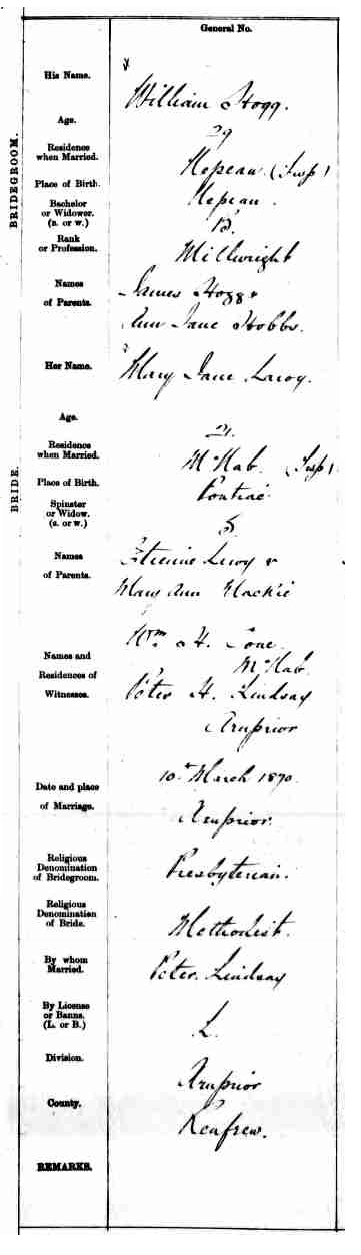
On the 10th of March in 1870, a Methodist wedding was held by Peter H. Lindsay in Arnprior for the 21 year old Mary Jane and her suitor. William Hogg (29), a Millwright from Nepean, son of James Hogg and Ann Jane Hobbs married the daughter of “Etienne Lavoy” (note the spelling) and Mary Ann Mackie. The wedding was witnessed by William H. Cone (Mary Jane’s brother-in-law, married to her elder sister Nancy) who was living in McNab township at the time.

One year after her marriage to William, Mary Jane Hogg was documented on the 1871 Canadian census. She and her husband are living with her parents and siblings. They have had their first child, a daughter named for her grandmother, Mary Ann Hogg, who at the time was only 2 months old. This means that she was conceived not long before the wedding (and possibly this spurred the marriage). What interests me about this census document is the fact that her parents are listed as illiterate, while Mary Jane and William are able to read and write. Also notable on this record is that Mary Jane’s elder sister Nancy Cone and her family live next door. This was likely a tightly knit and financially interdependent family group.

Within the following decade the Hogg family moved into a home of their own in the “unorganized territory” of North Renfrew (meaning that it had not yet been divided into townships), which they would have purchased on a Millwright’s salary. By this time William (40) and Mary Jane (33) were supporting 3 children: Mary Ann (now 12),  William Jr. (8), and Louisa (3). I am still trying to define what type of Millwright William was: I know later from his death certificate (read on further for this) that he operated a mill himself. Along the Madawaska River there were many mills where entire towns were built around them. For example, Arnprior proper was originally centered on the shop, grist mill and saw mill, in the early 1830s. By the 1870s, Arnprior had become one of the largest shipping points of lumber in Eastern Ontario (pg.6, Town of Arnprior Downtown Heritage Conservation District Study). There are still examples of some of these old mills in existence, such as the McDougall Mill Museum which I visited with my classmates as a child.

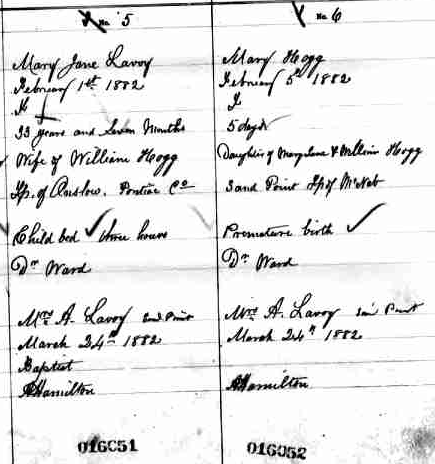
Despite the family’s apparent relative prosperity, it was not to last. Mary Jane Hogg, a 32 year old woman, died giving birth to their 4th child, Mary, in the following year.  The informant of her death was Mrs. A. Lavoy, who might have likely been Agnes Lavoy (my great x 2 grandmother, married to Mary Jane’s brother Peter). Sadly, despite the successful live birth of the baby girl on February 1st, 1882, she died 5 days later as a premature infant.

And so, the Hogg family of four was left without a wife/mother and feeling the loss and emptiness that came with the death of an infant. It would have been a devastating blow, as the children were all quite young. After Mary Jane’s death, the family moved on in separate directions.

I’ve been unable to successfully track her widower William Hogg through the 1891 census, although he may have been living with a brother in Lanark county (this needs verification). He eventually moved to North Bay as his children also did. He died on March 30, 1898 in Nipissing District from congestion of the lung. The record of his death confirms that he was born in Nepean, Ontario and that he was a mill owner.

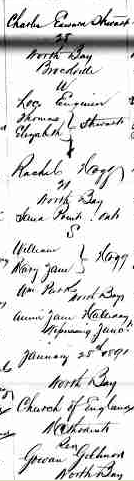
On the 28th of January, 1891 the first child, Rachel Hogg (who then claimed to be 21), married a 28-year-old locomotive engineer and widower called Charles Edward Stewart. Born in Brockville, he would have moved out to North Bay  as the Leavoys and Hoggs had done for work. They stayed in North Bay as long as work was available, but moved westward with the family they raised. By 1901, Rachel (29) and Charles Stewart (40) were living in Brandon, Manitoba neighbouring a John Lavoy (39, Hotel Manager) and his family. This was likely a cousin to Rachel, although I have yet to place him. They had a family of three children: Charles Jr. (17) and Florence (16) from Charles’ first marriage and William (7) born to Rachel and named for his grandfather. Eventually Rachel ended up out in Hanna, Alberta where she died at age 58 on September 2, 1929.
The older children, William Hogg Jr. and Louisa also moved to Nipissing as their sister and father had done. The brother (27) and sister (21) can be found living together in the 1901 census, surviving on William’s $900/year salary as a lumberman. The fact that the two stayed together is somewhat reassuring as it seems that the family may have dissolved somewhat with the death of their mother some two decades prior. By this time their father, the mill owner, had passed away too, and their older sister was now married and in Manitoba. This is the last I have found on the siblings, and would love to know what became of them.


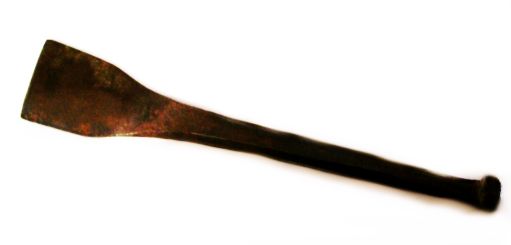
Time travelling with the help of a caulking iron

There are many descendants of the man called Achan Lavoy. They may know him as Ecan or Aken or Edward or Etienne, but regardless of the spelling, most individuals seem to be aware of his mythic appearance in Canada from France. I have written of his work as a cook for the lumber camps during the winter months, but one thing I have not written much of is his life in the boat building industry. A valuable skill during the 1800s in a region that was heavily logged, this was also passed down to his son, my ancestor, Peter Leavoy.

Descendant, Lanney Lavoy has kindly contacted me regarding this aspect of Achan’s life. He has been fortunate enough to inherit some relics through the generations: objects that allow us the opportunity to time travel and imagine the life of our ancestor in the late 1700s and early 1800s. Lanney seems to have grown up in the seat of some prime Leavoy territory, Carlow Ontario.  William Lavoy and James E. Lavoy, sons of Achan, and their families lived in Carlow and were buried in the cemetery there. This descendant first tipped me off to his own family’s immediate connection to Achan with an exciting comment:

“My grand father, Edward Andrew (Ned), grandson of Achan, told me Jim Mackey (Achan’s father in-law) was a ships carpenter. I have a caulking iron that came down through the family [and] there was also a ship builders adze but the where abouts are unknown at this time. […]The history of that area at that time was very interesting and ship builders and carpenters would have been a much needed trade.”

With Lanney‘s permission, I have decided to post photographs (left) of the one relic he was able to find and document. These images are of the caulking iron: an object whose worn texture can transport us to a time 300 years ago. Achan Lavoy was in possession of this tool and it quite possibly even came from his father-in-law, Jim Mackey. Achan and/or Jim would have used this 12 inch long iron with a mallet to drive tarred rope into the joints between wooden planks on a boat. The hammer marks that are clearly visible on the tool suggest that it was hand forged. These images, however small, give us all an opportunity to imagine an era and a lifestyle that we are only a few generations removed from today.

Thank you to Lanney Lavoy for sharing these photographs.


What about all those other Leavoys?….Harriet Kerr

Harriet Lavoy, or Hariot as her name is often recorded in census documents, is a difficult woman to trace. As such, this record of her life will be somewhat incomplete. I urge any descendants of this woman to reach out and fill in the gaps where they can.

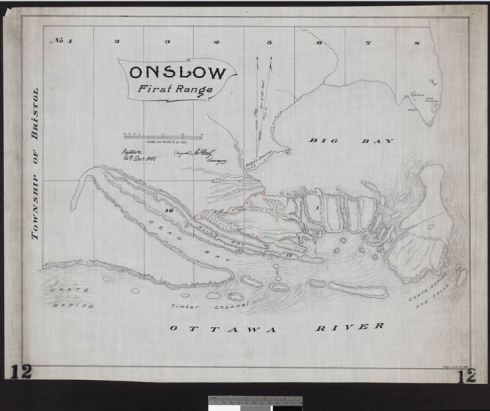
The third child of Achan Lavoy and Mary Ann Mackay, Harriet was born on the 28th of January 1846 in Onslow, Quebec. Onslow (or The Quio as it was often called at the time) was a small settlement:  it was not yet established as a municipality, did nt yet have a local church built, but was simply where the lumbermen of the region would come to buy food. Some of the land had been bought up, logged, and farmed with potatoes, oats and cattle by 1840.

Ten years prior to Harriet’s birth, the Chats fur trading post off of Lac des Chats, which was central to the region, closed down. The Indians whose hunting grounds were located around Onslow were displaced from the area, and it went from a region of fur trade to shipping and lumbering of White Pine. Two saw mills on Pontiac Bay, just upstream, made the area an ideal location for lumbermen to work, as her father Achan would have done. Pontiac Village became the first real settlement to grow up in the area, and this, or the nearby Eganville, is likely where the family lived. The growth of this settlement was largely due to the traffic on the Quio and Ottawa rivers that had increased when a 3 mile long horse drawn portage train was built beteen Pontiac Bay and Lac des Chats. (This information comes from the Onslow and Quyon History)

An early survey map of Onslow, made the year prior to Harriet's birth.

I haven’t yet found the Lavoy family documented until 1871, long after Harriet left home and married. With research done by family historian, Robin Murphy, and from descriptions in The Wilfred Ronald Leavoy Autobiography by Garnet Leavoy, I can imagine how her childhood may have been. She would have stayed in the Onslow area of Quebec until roughly age 16, when her father moved the family across the Ottawa River to follow the logging into the Sand Point area around Arnprior. Her father would been gone for 5-6 months a year with his crew out in the snowy forests as the camp chef. Her mother would have been left to tend the children on her own. The Lavoy children were purported to be some of the first white children born in the Pontiac area, and it would have been a rough and lonesome space for children.

When she was 19 years old, Harriet met and married a 27-year-old farmer named James Kerr. On the 10th of April, 1865, the couple said their vows somewhere in Pontiac. Historical records show two possible locations for their marriage in Pontiac: St John the Evangelist church, which was built in 1855, or the Onslow Mission (Methodist), built in 1859.

My first record of the new Kerr family is in the 1871 census, placing them in the community of Ross in North Renfrew. The other Lavoy family members also resided in Renfrew at the time, so James (32) and Harriet (24) may have followed her family in that direction. Having been married for about 6 years, the couple had three sons: John William who was born within a year of their wedding and was now 5, Andrew who was 3, and baby James Jr. The family farmed and belonged to the Church of Scotland.

The family stayed in Ross for the following 20 years where they continued to farm. I have located them on the census of 1881, which is badly faded and nearly illegible. Despite this, it clearly shows that the family has hardly changed in its dynamics: it has merely aged. James (40), “Hariot” (31) and their 3 sons: William John (15) who works with his dad on the farm, Andrew (13) and James Jr. (11) all still live in the same location ad attend the same church. It looks as though James and Harriet had no more than their 3 children, quite a change from the Lavoy generation before.

In the census of 1891, the household has enlarged with the addition of the eldest son, William‘s new Scottish-born wife Jennie into the home. They had a Presbyterian marriage in Renfrew on April 10, 1899 witnessed by both sets of parents. There is also a young lodger who may have helped on the Kerr farm or paid rent to the family. Other interesting details on the census include the  birthplaces of James (53) and Harriet (39). He is listed as being born in Scotland, whereas previous documents point to Ontario. She is listed as an Ontarian by birth as opposed to Quebecois. The other sons are now adults and also likely helping their father in his labour.

The following years brought dramatic change in the life of the Kerr family. The two other sons were married in the summer of 1892. On the 20th of July, Andrew, the 2nd son, was married to Harriett Ellen Thomson in Horton, outside of Arnprior. Their marriage was witnessed by James Kerr Jr. and Harriett’s sister Sarah. Then, only a few weeks later, on August 10th, the youngest son James Jr. married Jennie Frood in Horton. Sadly, the growing family was hit hard on October 15, 1894, when Jennie McConnell who was only 24, died of consumption, leaving William a young widower only 5 years after his marriage.

William met another woman and did remarry: Charlotte Wilson, a woman 13 years younger than he and from Bagot, became his bride on the 23rd of March 1904.  The three sons and their wives all followed in their father’s path, continuing to farm the land in the Arnprior area.

Thank you to Deb Lavoy for answering my questions about William.


What About All Those Other Leavoys?…Hannah Taylor

Continuing my determination to gather up and tell the stories of all of Achan Lavoy and Mary Ann Mackay’s children, here is my second installment in a series of posts on the stories of all those other Leavoys.

Hannah Lavoy was the second child born to Achan and Mary Ann. Census records date her birth as June 20, 1844, somewhere in the province of Quebec. Hannah would have lived in the Renfrew-Arnprior region of Ontario in the early years of her life, while her father farmed for half of the year and laboured with the lumber camps in the winter months.

Sometime around 1860, she met and married Enoch Taylor, an immigrant from England.  He arrived in Canada in 1849 when he was a boy of 9 years old, so one can imagine that he was well settled as a Canadian citizen when they met. Their first child whom I have record of from Canadian censuses, Rachel Taylor, was born in 1862 in Quebec. Therefore, my assumption of the marriage date wouldn’t be that far off.

Hannah and Enoch settled in West Toronto sometime before the census of 1871.  They resided in St. Patrick’s Ward, where Enoch (sometimes listed as “Amos”) worked as a painter.  This career would have barely fed and housed himself and Hannah, their 7-year-old daughter Rachel, and their 6-month-old baby William. Looking at the neighbouring families on the census, there is a sense that the diversity of St. Patrick’s Ward at the time would have made for the company of many others trying to get by as actors and shoemakers and labourers.

In the 1881 census, the family still resides in Toronto West (St. Patrick’s Ward), surviving on “Enos“‘s earnings as a painter. They now have another child for Hannah to care for, Frederick, who is 4 years old. Rachel, 18, is probably helping her mother care for Frederick and William E. who is 10 and is attending school. One year later, Rachel moved out and married a man named Albert Edward Moore, a scale maker from Kingston, and they moved into their own home in town to have a family.

After another 10 years went by, I found that the Taylor family stayed in St. Patrick’s Ward, making it an official home (they’d now been there for more than 20 years). It isn’t known to me whether or not they kept in touch regularly with the Lavoy side of the family. Looking at the 1891 Canadian census reveals that Hannah‘s husband, “Enos” likely had some difficulty paying all of the bills as a housepainter. They allowed a lodger into their home, who would have helped out and paid some rent to the family. A gentleman of 56, I wonder whether he would have had enough of an income to pay the Taylor family his dues, but this is simply speculation. As Rachel and William had grown up and moved out of the home, the extra body wouldn’t have taken too much additional space. Frederick Charles was now a growing adolescent of 14 years and another daughter, Lena A. (4 years old) would have been a growing handful.

In the 1901 census, Enos (62) and Hannah (57) are middle-aged. While Enos continues to work, they have settled on the additional income of a lodger and now have a 58-year-old woman from India living with them.  Frederick has moved out on his own and married to a woman called Anna Smiley in 1899, and the couple is left with their youngest, Lena who is 14. The beauty of this census record is that it gives dates of birth for each of these individuals. Lena married three years later to a clerk named Wallace Goodfellow.

The last census record available for this family is from 1911. Here the address of their dwelling is given: 71 Vanauley, now the site of a tavern and live performance venue in a lovely tree-lined square. Enos (70) and Hannah (66) are living again with Lena Alberta (21),whose husband recently died. They had only been married for one year before Typhoid killed him at such a young age.  Now all three of the Taylors are living together, unemployed. There is no lodger in the home, and they must have found it difficult to survive at their age.

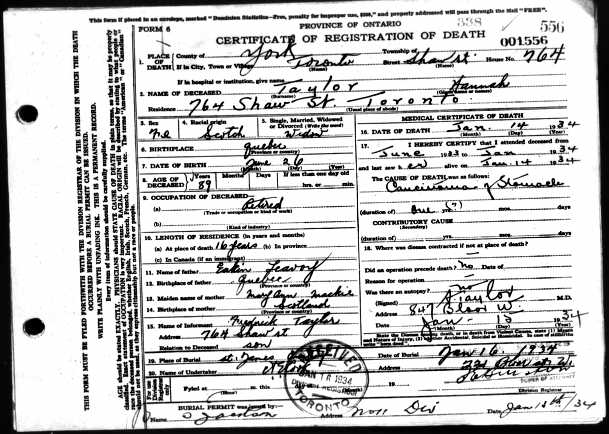
Enos died 2 years later on June 25, 1913 while they still lived at that address. He was 75 years old and appears to have simply passed from his long years of labour.   Hannah lived for many more years, until the age of 89. On January 14, 1934, she died of stomach cancer which she had been treated for by her physician for about a year. Her death record shows that she had been living with her son Frederick at his home for 16 years after the death of her husband, at 764 Shaw st. and he was the informant of her death. She is buried at St. James Cemetery.