
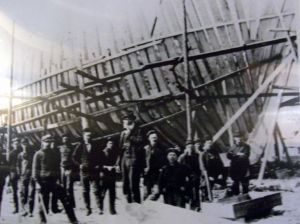
 There are many descendants of the man called Achan Lavoy. They may know him as Ecan or Aken or Edward or Etienne, but regardless of the spelling, most individuals seem to be aware of his mythic appearance in Canada from France. I have written of his work as a cook for the lumber camps during the winter months, but one thing I have not written much of is his life in the boat building industry. A valuable skill during the 1800s in a region that was heavily logged, this was also passed down to his son, my ancestor, Peter Leavoy.
Descendant, Lanney Lavoy has kindly contacted me regarding this aspect of Achan’s life. He has been fortunate enough to inherit some relics through the generations: objects that allow us the opportunity to time travel and imagine the life of our ancestor in the late 1700s and early 1800s. Lanney seems to have grown up in the seat of some prime Leavoy territory, Carlow Ontario. William Lavoy and James E. Lavoy, sons of Achan, and their families lived in Carlow and were buried in the cemetery there. This descendant first tipped me off to his own family’s immediate connection to Achan with an exciting comment:
“My grand father, Edward Andrew (Ned), grandson of Achan, told me Jim Mackey (Achan’s father in-law) was a ships carpenter. I have a caulking iron that came down through the family [and] there was also a ship builders adze but the where abouts are unknown at this time. […]The history of that area at that time was very interesting and ship builders and carpenters would have been a much needed trade.”
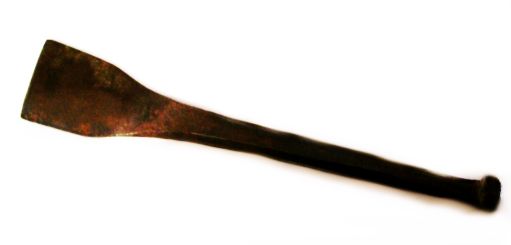

With Lanney‘s permission, I have decided to post photographs (left) of the one relic he was able to find and document. These images are of the caulking iron: an object whose worn texture can transport us to a time 300 years ago. Achan Lavoy was in possession of this tool and it quite possibly even came from his father-in-law, Jim Mackey. Achan and/or Jim would have used this 12 inch long iron with a mallet to drive tarred rope into the joints between wooden planks on a boat. The hammer marks that are clearly visible on the tool suggest that it was hand forged. These images, however small, give us all an opportunity to imagine an era and a lifestyle that we are only a few generations removed from today.
Thank you to Lanney Lavoy for sharing these photographs.


 Oh What a Tree