
Hans Peter Rasmussen’s father, Niels Rasmussen was 46 years old in the 1880 Danish census, making his year of birth around 1834. He was born in Vissenbjerg, which is on Funen island. He was a carpenter.
In the Danish census, each person is given a number that indicates order of visitation. This is helpful because it also shows who is a close neighbor. In the 1880 census, Hans is #708, which led me to search adjacent numbers outside of the family to see who lived close by. What I found were a few other Rasmussens who might likely be relatives:
| Ole Rasmussen | 53 | Married | as a carpenter | Øreskov in Jutland | |
| Ane Katrine Datter | 59 | Married | his wife | Rørup | |
| Ludwig Rasmussen | 13 | Single | of their son | Wissenberg |
Ole Rasmussen could be a brother to Hans’ father, Niels. His order number in the census is 716, so he lived next door. His address is the same mysterious Hoime city, and the house is called “Holme” site. His place of birth, however, is Jutland, which is the Danish mainland. So, if he is a brother, it means that at some point Niels sr. lived there. Ole’s son, Ludwig, was born in Wissenburg, like Niels Jr. If I can find an earlier census with Niels Rasmussen’s family I may be able to confirm whether or not there is a family relationship.
Another neighbouring family also has the surname Rasmussen, and they are the next family away. Jacob, could be yet another older brother to Niels Rasmussen Jr. His daughter, Anna Kirstine takes his paternal name as her surname:
| Jacob Rasmussen | 69 | Widow (male) | living on his plot | Langeland | |
| Anna Kirstine Jacobsen | 38 | Single | his daughter and housekeeper | here in the parish [Sanderum] |
While I can’t confirm the relationship of these neighbouring Rasmussen families, I have found a basic migration through the island Funen (Fyn) of 3 generations of our Rasmussen family. From this single census I have discovered my greatx3 and greatx4 grandfathers.
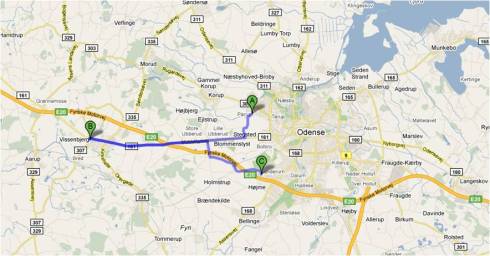
This shows the migration of the Rasmussen family within Denmark between 1795 and 1880. We know that Niels Rasmussen Sr. was born in Paarup (A) in 1795. His son, Niels Rasmussen Jr. was born in Vissenbjerg (B) in 1834. The third generation, Niels Rasmussen Jr.’s children including Hans, were all born in Sanderum parish (C) between 1870-1880.
What drove the Rasmussen family to move about from one parish to another with each generation during the time between 1795 and 1880? The area where the family moved is not very large: it is about 16 miles from Vissenbjerg to Odense, so this could be travelled easily within a day. In order to understand this movement around Odense, we need to look at economic/demographic factors including land reform, industrialization and population growth.
The Danish economy traditionally specialized in agriculture like most other small and medium-sized European countries, however, it is rather unique in that it retained a strong agrarian bias well into the 20th century (Henriksen). The Rasmussens likely participated in this agrarian culture of subsistence farming throughout their Danish history. They were probably living in a difficult feudal system where they remained poor and with little to no rights. The experience of peasant farmers in the early to mid 1800s has been recorded by Danish-American emigrant, August Rasmussen (may or may not be of relation). He and his wife emigrated to America in 1856 (35 years earlier than our Rasmussens) to escape this poverty and to experience the freedom of an elected president as opposed to an absolutist monarchy. In his published journal, he wrote of his experiences in Denmark:
[…] here was neither land nor opportunity for us. We were slaves to the government, the nobility and to the authorities, both temporal and religious. Our rewards were miserable food and poor wages. Whether or not a man enjoyed his legal rights depended entirely on the question of wealth. The squires demolished our fathers’ houses and farms, and the small plots were added to the large estate fields. These same men accumulated houses and fields until there was no more available land in the country. Thus the squires alone could remain there, bringing God’s woe upon themselves. […] I gave my back to the squire’s cane and my jersey to the first lieutenant’s flat of the sword and my cheek bone to the farm bailiff’s slap on the ear. Beatings and blows were not allowed, but those in charge did still hit the little ones. They knew our rights were non-existent. (Andreasen)
We can imagine that Hans’ father and grandfather, Niels and Niels Sr. were living in a similar climate as the majority of the Danish population were peasant farmers. However, according to Danish economic historian Ingrid Henriksen, during the late 1700s Denmark experienced rise in population which triggered great technological innovation and also land reform.[i] While prior to 1750, Denmark had the feudal system that bound peasant labourers to the land where they were born, for Niels Rasmussen Sr.’s generation, this feudal system slowly became obsolete and landlords no longer needed to bind labor to their estate. A new class of landless Lutheran-Protestant laborers or cottagers with little land emerged, and it became more economic for the Crown to sell off land and tax the peasant farmers themselves. This meant that as a result of this change in population, two-thirds of all Danish farmers became owner-occupiers compared to only ten percent in the mid-eighteenth century (Henriksen). The Rasmussens may have bought farm land during this period from the late 1700s into the mid 1800s and so they could have owned their land in Sanderum.

An image of an old Danish house in Sandurum, Odense, Denmark,a parish where the Rasmussens lived in 1880 and where Hans was born. The image comes from Odense City Museums and no date was on the back. (http://museum.odense.dk)
It is also likely that there were more amenities and greater potential for economic growth closer to the urban environment in Odense in the late 1800s. Looking at the history of Denmark in the 1800s, I have found that industrialization really began in the 1840s[ii], not long after Niels Jr. was born in Vissenbjerg (1834). It is possible that his family wanted to move closer to the city to profit off of the new industry? We might consider is how Odense, the city that the Rasmussens remained close to, grew and modernized considerably during this time as another possible factor for the family move closer to the city from Vissenbjerg to Sanderum. In A History of Odense, these changes in the city are outlined:
Odense became a port with the opening of its canal in 1803; the roads around the town were improved and from the 1840s the town really began to expand out of its old boundaries. For many years, Odense was second only to Copenhagen in Denmark. The town gates disappeared in 1851 and a few years later, the town spread south of the river. It was the first Danish town to get modern water and gas works in 1853 and with the arrival of the railways in 1865, all the conditions were in place for rapid industrialization. Iron and metals, textiles, food and beverages soon became central elements of the town’s commercial life and separate industrial and residential areas started to appear. (A History of Odense, 2009)
Niels, Hans’ father, is listed in the 1880 census as a craftsman and may have worked with wood or metal that came in from the port in Odense. In any case, living close to Odense might have benefitted the family with potable water and access to goods traded through the port town. By the 1880s the majority of dairy producers in Denmark, particularly nearest to the city, were cooperatives. The new steam-powered continuous cream separators allowed workers to produce butter faster and more efficiently. It is very likely that Hans Rasmussen worked as a young labourer for a dairy farm or creamery prior to immigration (see immigration record from Denmark).[iii] In this case, living in Sanderum, outside of Odense would have been beneficial for this new wave of agricultural technology. Finally, we can also imagine that Hans might have begun his migration to America from the port in Odense, travelling to either Hamburg, Germany or Copenhagen.
Niels’ wife, Maren Kristine is 50, so her year of birth was likely around 1830 and she comes from Sanderum. Her last name is Nielsdatter– which indicates that for her generation, paternal naming was used as opposed to actual surnames. This makes it very difficult to trace her (although I will continue this search the best that I can). Niels Rasmussen and his wife Maren might have married in Sanderum, where Maren was born, eventhough Niels had come from another parish. This family also lives with Niels’ father of the same name who is 85 years old and widowed. We can glean from his age that his year of birth was about 1795, and his birth place is listed as Porup (or Paarup) parish which is also in Odense county.
[i] My research on the history of Denmark comes from a paper titled An Economic History of Denmark by Ingrid Henriksen from the University of Copenhagen (Henriksen). In this history, she outlines the causes for population growth after the Black Death and complicates the understanding of industrialization’s impact on population and economic growth.
[ii] This dating of early industrialization comes from the website: “Vikings and History” and the article titled Industrialization. <http://www.um.dk/um_files/denmark/kids/denmarkKids151.htm>
[iii] In the immigration record from Denmark, Hans’ occupation is listed as “Tyende (m/k land)”. The word Tyende translates as servant, but this likely means a labourer to a farm (land). (Danish National Records, 2006)
[iv] It appears that in general, Danish “V” sounds are spelled with a “W”, so this would match my suspicion.

 Oh What a Tree
May 26th, 2014 at 10:14 pm
In your research, did you ever come across a man named Niels Frederick Rasmussen born April 1856 and his wife Rudolphine Ulrickson? I am wondering if they are from the same family. My great grandfather (Niels) came from Funen Island. They had a child in Denmark by the name of Marie Sophia Rasmussen. I believe that came over in their 20’s. I am stuck in my genealogical research and I came across your information. Thank you for your time.
February 10th, 2025 at 11:27 am
Hello, I have not yet come across Neils Frederick Rasmussen but I will keep an eye out. This is a tricky line to untangle!
June 18th, 2014 at 5:33 pm
I found this historical account very interesting. Sounds like my ancestors, same time period, same location.
November 30th, 2016 at 5:13 am
I am James Herrick. My Grandmother is Ethel Wachtier, married to a Beck. He had the name Beck because the father of Soren Rasmussen had passed away on a ship. The Beck family took Soren as their son. He became known as Soren Rasmussen Beck ( Soren R. Beck) at that point. I am told that our uncle was Erik the Red 7x removed also but can’t confirm it. If you have information email me. Also any other details about my family history. My Grandmother was the daughter of the Chief of the Cree tribe, her mother was French Canadian. I am related to Hans and Niels Rasmussen as my mother had told me many years ago. I intend writing about it. My father is pure Scottish. A ship bringing Joseph Smith and many royalty to America, having built the ship with their wealth stopped in Scotland. Roughing the weather they had started to America from Scotland then turned back in severe weather. They started again and the storm came upon them a third time so they just weathered through it to America. They became the modern Mormons in Utah. Toby Hansen of Missoula told me his aunt took a leadball to her chin survivng when a group left Brigham Young disagreeing regarding his belief he was the successor to their Prophet Smith. Young won the battle. I had told Toby some of the tale of my family’s struggles and their settlement in Deer Lodge having homesteaded Upper Ranch near Garrison- Helmville and Lower Ranch in Deer Lodge. My Grandfather owned the Lead King Mine in Garnet, Montana in the Garnet Range. My mother and father met in Northern California. It may be their ancestors were enamored at their story in Scotland as I perceive. My fathers father Joseph Herrick was in Butte, Montana at the Butte Mine around turn of century-1900 as a child. He and his mother returned to Northern Cal. on a train in the winter riding on top in blizzard conditions. Mining was a job my G’Pa couldn’t continue. My cousin Don Beck of Garrison Ranching mentioned he had worked there also. He is approx. 66 Y.O. My ancestors had crossed paths again. I had heard of an Uncle Dune who was a Scot also. I hope you enjoyed this legacy. There is more on the Mountain Years. The City Life my of Legend James Patrick Christopher Herrick, King Of Hollywood, Coronated in David Lee Roth’s Galaxy Club (private after- hours club proceeding Raves started by Anthony B. Carlysle who I told of the private club). He being my friend and Sound Tech; I his roadman at Jezebel’s Nightclub, Anaheim (named after German Ana’s Home. So. Cal. also) Whilst I had aspired at acting, modeling, dancing, cameraman, Talent Scouting with Dennis Tracy and Associates, writing, Casting associate and more additionally) midnight New Years 1987-1988. Thence and thereupon it being Anniversary 100 of the District of Hollywood dated around mid February 1988. I decreed my first and only undecreeable decree as that I will be King for 100 years dead or alive. God so help me. Now their exists the actual City of Hollywood. D.H. was a housing subdivision like D.C. It was named after the holly growing in the hills similar to the holly in Great Britain where the subdivision owner was from. More On the 30 years in the city included at some point in my books, 30 Years In The City, 30 Years In the Country. I will soon be 61 but tell most I am 48. It’s brainwork to extend the cause of my 100year reign.
February 10th, 2025 at 11:18 am
A long story – these histories get tangled don’t they. I am not aware of many of these connections and they would be interesting to explore. Thanks for sharing!