
 Hans Peter Rasmussen was born in Sanderum parish, Odense County, Denmark in approximately 1870. Unlike many other relatives whom I’ve followed through census documents, Hans P. Rasmussen’s date of birth is very consistent. It can be found in three American censuses which all list his place of birth as Denmark. By applying this information to Danish immigration records (Danish National Records, 2006), I have found his birth town.
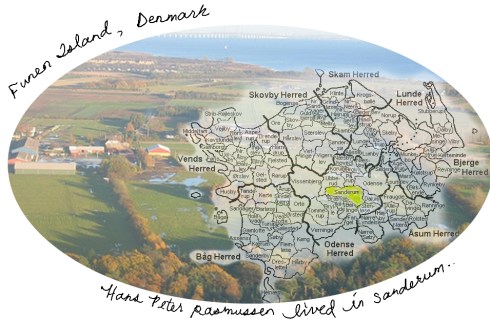 In the Danish census of 1880, 10-year-old Hans lives with his family of 6 people in Sanderum. There is his father, Niels Rasmussen, a 46-year-old craftsman originally from Wissenberg, and mother Maren Kristine Nielsdatter who is 50 and from Sanderum. Hans is the same age as his sister, Karen Marie, who must have been his fraternal twin. He also has a younger sister called Ane Katerine who was 7 years old at the time (3 years younger). The children are all listed as being born “in this parish” (Sanderum), which means that the family has resided there for at least 10 years (since 1870). The family is not originally from Sanderum, however, as the father and the grandfather are listed as having been born in other parishes.
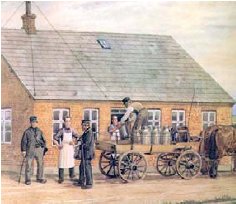 It is very likely that Hans Rasmussen worked as a young labourer for a dairy farm or creamery prior to immigration. His immigration record from Denmark (below) lists Hans’ occupation is listed as “Tyende (m/k land)”. The word Tyende translates as servant, but this likely means a labourer to a farm (land). By the 1880s the majority of dairy producers in Denmark, particularly nearest to the city, were cooperatives. The new steam-powered continuous cream separators allowed workers to produce butter faster and more efficiently. In this case, living in Sanderum, outside of Odense would have been beneficial for this new wave of agricultural technology.
Looking at the Danish Immigration Archives, I have found a match to Hans Peter Rasmussen. His age (21) and immigration date (1890) match information on American censuses, as does his destination is “Cedar Falls, Iova, USA”. The first place where I have found Hans in the USA is, in fact, Cedar Falls, Iowa. This match is so close, that I am sure it is him. What I gathered from this record was that Hans was living in Sanderum, Odense prior to immigration (I used this to find him on the 1880 Danish census). His route to America was indirect, but he had a very specific destination, Cedar Falls, in mind.
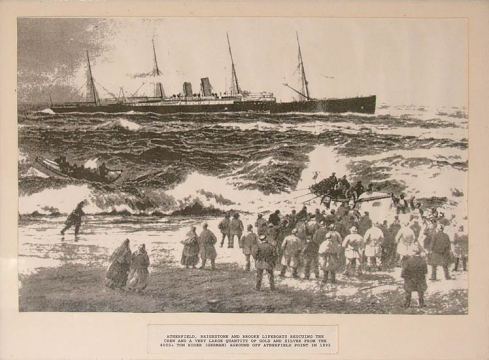
The German ship, Eider (1892)
Hans might have begun his migration to America from the port in Odense, travelling to either Hamburg, Germany or Copenhagen.
 Ten years later, the 1900 census record for Cedar Falls, Black Hawk county, Iowa shows Hans Peater, who here goes by “Peter”. He had arrived and begun farming, had married and started a family.
His wife Mary appears to have arrived in America from Denmark in 1892. I have yet to discover her maiden name, but imagine that when the marriage certificate of the couple surfaces, so will this crucial detail. What I do know about Mary is that she was also a Danish citizen before coming to America. She was born in Denmark in November of 1870, to Danish parents. According to several U.S. censuses, Mary and Hans Peter married in 1893 and remained so until at least age 50 (which is the last point where I have found the couple documented thus far). It is currently unknown as to whether the couple knew each other before coming to the United States. As they had both arrived in America prior to their marriage, it is safe to believe that they were married on U.S. soil. It is also likely that Mary arrived in New York, which was the largest port in North America at that time in history. They might have been married in New York. The other possibility is that they married in Iowa (where their first child was born one year later) or somewhere between New York and Iowa.
 This 1900 census paints a picture of how the young Rasmussen family lived in their early establishment as an American family. Hans Peter (age 31) had now been living in the United States for 10 years and is listed as ‘naturalized’, and Mary Berta (age 29) had been in the country for 8. They had been married for 7 or 8 years and now had four young children (ages 1-6). The Rasmussen family lived on a rented farm. Most neighbouring farms were rented and it appears that many of the other families in the community were Danish, although the community was a mixture of various backgrounds: American born, Scottish and English. The Rasmussens had close neighbours who were from Denmark: the Guldagers, the Jorgensens, the Morgensens & the Sorensens. I have compared their listed dates of arrival in the U.S. with those of Hans Peter and Mary and it appears that many of the neighbouring Danish families arrived around a similar time period, especially in 1892, which is when Mary Berta arrived. It could likely be that one of these families is of relation to either Hans or Mary. I am sure that in any case, they had some comfort living near other families from their home country who were of a similar age who also had young children. We know that the family must have been integrating well as both Hans Peter and Mary Berta can read, write and speak English.

On the 1905 Wisconsin state census, Hans, who is going by the name “Peter” is now 36 and Mary, who is 34, is going by her middle name as well: “Berta”. Their 5 children range in age from 4-11. Their move from one state to the next is significant because West Luck, Wisconsin was a Danish community in entirety– founded and inhabited by Danish immigrant families some 35 years prior. It was incorporated with its Eastern half in 1905 when the family moved, and the railroad came to town 4 years prior in 1901.
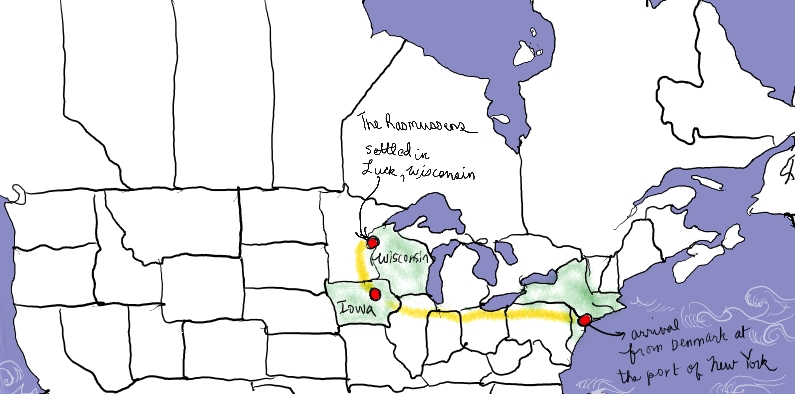
Hans & Mary likely came to the U.S.A. through N.Y., moved to Cedar Falls, IO and then settled in Luck, WI.
My thoughts about this are that other members of Hans P Rasmussen‘s or Mary Berta‘s extended families were likely living in Luck. When I find Mary Berta’s maiden name, more research can be done with this census. The other significant point to this move is that Hans P. went from renting a farm in Iowa, to owning a farm in Wisconsin. The historic ‘West Denmark settlement’ of Luck, where the Rasmussens resided is the site of the first cooperative creamery in the United States, so while I do not have the specifics of the Rasmussen farm as of yet, it may have included some form of dairy production.
The Rasmussen family continued to live in Luck, Wisconsin for at least another 5 years. Another federal census was taken in 1910 (above), recorded the family living on their “General farm” which they now had a mortgage on. “Hans P.” is 40 and his wife “Mary B.” is 38- they’ve now been married for 17 years and their children are aged 9-16. Rasmus N., Berthilda, Anna & Marius are all attending school, while Clara who is now 16, works as a servant to a private family.
 Sometime within the following decade, Hans & Mary’s eldest daughter Clara married Edward Donahue. They lived together in Saskatchewan, north of the Canadian border. I have also found a record of the Rasmussen family: Hans P. (49) and “Mrs. Rasmussen” (Mary B.) along with their two daughters Berthilde (21) and Anna (19) crossing the border from the U.S.A. into Canada on March 9, 1918 (see below). They traveled by train, and when crossing the border stated that they were coming from Luck, Wisconsin and that their destination was Gull Lake, Saskatchewan. It appears that Hans is still farming in the same town as he was on the 1910 census and that he has a significant amount of money with him as he travels north- $6000.
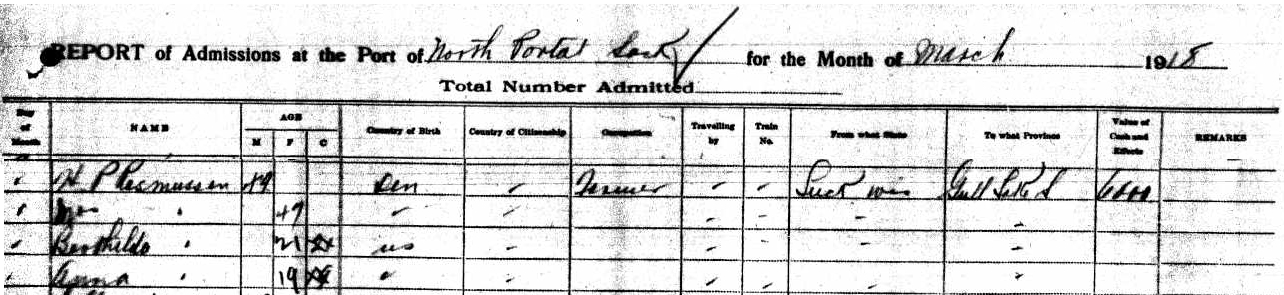 Why were Hans and the Rasmussen women traveling to Saskatchewan with all of this money? I believe that it may have been for their eldest daughter’s/sister’s wedding to Edward Donahue. If not this, then they were at least visiting the couple whose first child was born the next year. Knowing that the trend was often to start a family soon after marrying, my guess that Clara and Edward were married in Gull Lake in 1918 is at least an educated guess.
On this trip north, both brothers- Rasmus and Marius- were not present. I have tried to figure out the reason for this and have one theory. In September of 1918, 6 months later, Rasmus signs his WW1 registration card. On it, he claims that he farms on his own in Gull Lake, Saskatchewan. Therefore, it is not far off to believe that he was living there prior to his parents and younger sister’s visit. Could Marius have also been farming in Saskatchewan? Unfortunately, Rasmus states that he has no next-of-kin to contact on his WW1 draft card- strange. We do know, however, that from Rasmus’ last will and testament (sent to my father, his great-nephew) that he died in 1978 in Saskatchewan. It seems that he spent the rest of his life as a Canadian.
I am unsure as to whether or not the rest of the family moved up to Canada or if they simply visited. this was the last record that I found of Hans & Mary B. Research on this family continues with a hunt for death records and marriage records.

 Oh What a Tree
Leave a comment