Category Archives: The Leavoy Line

What about all those other Leavoys?….Harriet Kerr

Harriet Lavoy, or Hariot as her name is often recorded in census documents, is a difficult woman to trace. As such, this record of her life will be somewhat incomplete. I urge any descendants of this woman to reach out and fill in the gaps where they can.

The third child of Achan Lavoy and Mary Ann Mackay, Harriet was born on the 28th of January 1846 in Onslow, Quebec. Onslow (or The Quio as it was often called at the time) was a small settlement:  it was not yet established as a municipality, did nt yet have a local church built, but was simply where the lumbermen of the region would come to buy food. Some of the land had been bought up, logged, and farmed with potatoes, oats and cattle by 1840.

Ten years prior to Harriet’s birth, the Chats fur trading post off of Lac des Chats, which was central to the region, closed down. The Indians whose hunting grounds were located around Onslow were displaced from the area, and it went from a region of fur trade to shipping and lumbering of White Pine. Two saw mills on Pontiac Bay, just upstream, made the area an ideal location for lumbermen to work, as her father Achan would have done. Pontiac Village became the first real settlement to grow up in the area, and this, or the nearby Eganville, is likely where the family lived. The growth of this settlement was largely due to the traffic on the Quio and Ottawa rivers that had increased when a 3 mile long horse drawn portage train was built beteen Pontiac Bay and Lac des Chats. (This information comes from the Onslow and Quyon History)
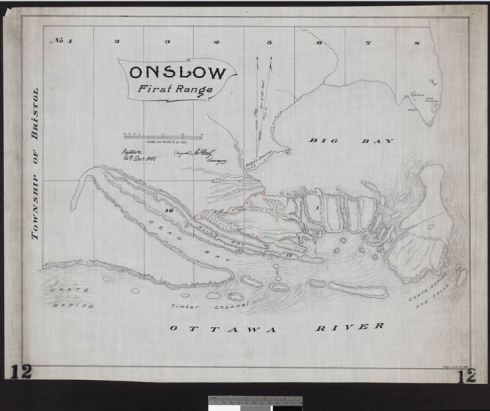
An early survey map of Onslow, made the year prior to Harriet's birth.

I haven’t yet found the Lavoy family documented until 1871, long after Harriet left home and married. With research done by family historian, Robin Murphy, and from descriptions in The Wilfred Ronald Leavoy Autobiography by Garnet Leavoy, I can imagine how her childhood may have been. She would have stayed in the Onslow area of Quebec until roughly age 16, when her father moved the family across the Ottawa River to follow the logging into the Sand Point area around Arnprior. Her father would been gone for 5-6 months a year with his crew out in the snowy forests as the camp chef. Her mother would have been left to tend the children on her own. The Lavoy children were purported to be some of the first white children born in the Pontiac area, and it would have been a rough and lonesome space for children.

When she was 19 years old, Harriet met and married a 27-year-old farmer named James Kerr. On the 10th of April, 1865, the couple said their vows somewhere in Pontiac. Historical records show two possible locations for their marriage in Pontiac: St John the Evangelist church, which was built in 1855, or the Onslow Mission (Methodist), built in 1859.

My first record of the new Kerr family is in the 1871 census, placing them in the community of Ross in North Renfrew. The other Lavoy family members also resided in Renfrew at the time, so James (32) and Harriet (24) may have followed her family in that direction. Having been married for about 6 years, the couple had three sons: John William who was born within a year of their wedding and was now 5, Andrew who was 3, and baby James Jr. The family farmed and belonged to the Church of Scotland.

The family stayed in Ross for the following 20 years where they continued to farm. I have located them on the census of 1881, which is badly faded and nearly illegible. Despite this, it clearly shows that the family has hardly changed in its dynamics: it has merely aged. James (40), “Hariot” (31) and their 3 sons: William John (15) who works with his dad on the farm, Andrew (13) and James Jr. (11) all still live in the same location ad attend the same church. It looks as though James and Harriet had no more than their 3 children, quite a change from the Lavoy generation before.

In the census of 1891, the household has enlarged with the addition of the eldest son, William‘s new Scottish-born wife Jennie into the home. They had a Presbyterian marriage in Renfrew on April 10, 1899 witnessed by both sets of parents. There is also a young lodger who may have helped on the Kerr farm or paid rent to the family. Other interesting details on the census include the  birthplaces of James (53) and Harriet (39). He is listed as being born in Scotland, whereas previous documents point to Ontario. She is listed as an Ontarian by birth as opposed to Quebecois. The other sons are now adults and also likely helping their father in his labour.

The following years brought dramatic change in the life of the Kerr family. The two other sons were married in the summer of 1892. On the 20th of July, Andrew, the 2nd son, was married to Harriett Ellen Thomson in Horton, outside of Arnprior. Their marriage was witnessed by James Kerr Jr. and Harriett’s sister Sarah. Then, only a few weeks later, on August 10th, the youngest son James Jr. married Jennie Frood in Horton. Sadly, the growing family was hit hard on October 15, 1894, when Jennie McConnell who was only 24, died of consumption, leaving William a young widower only 5 years after his marriage.

William met another woman and did remarry: Charlotte Wilson, a woman 13 years younger than he and from Bagot, became his bride on the 23rd of March 1904.  The three sons and their wives all followed in their father’s path, continuing to farm the land in the Arnprior area.

Thank you to Deb Lavoy for answering my questions about William.

What About All Those Other Leavoys?…Hannah Taylor

Continuing my determination to gather up and tell the stories of all of Achan Lavoy and Mary Ann Mackay’s children, here is my second installment in a series of posts on the stories of all those other Leavoys.

Hannah Lavoy was the second child born to Achan and Mary Ann. Census records date her birth as June 20, 1844, somewhere in the province of Quebec. Hannah would have lived in the Renfrew-Arnprior region of Ontario in the early years of her life, while her father farmed for half of the year and laboured with the lumber camps in the winter months.



Sometime around 1860, she met and married Enoch Taylor, an immigrant from England.  He arrived in Canada in 1849 when he was a boy of 9 years old, so one can imagine that he was well settled as a Canadian citizen when they met. Their first child whom I have record of from Canadian censuses, Rachel Taylor, was born in 1862 in Quebec. Therefore, my assumption of the marriage date wouldn’t be that far off.

Hannah and Enoch settled in West Toronto sometime before the census of 1871.  They resided in St. Patrick’s Ward, where Enoch (sometimes listed as “Amos”) worked as a painter.  This career would have barely fed and housed himself and Hannah, their 7-year-old daughter Rachel, and their 6-month-old baby William. Looking at the neighbouring families on the census, there is a sense that the diversity of St. Patrick’s Ward at the time would have made for the company of many others trying to get by as actors and shoemakers and labourers.

In the 1881 census, the family still resides in Toronto West (St. Patrick’s Ward), surviving on “Enos“‘s earnings as a painter. They now have another child for Hannah to care for, Frederick, who is 4 years old. Rachel, 18, is probably helping her mother care for Frederick and William E. who is 10 and is attending school. One year later, Rachel moved out and married a man named Albert Edward Moore, a scale maker from Kingston, and they moved into their own home in town to have a family.

After another 10 years went by, I found that the Taylor family stayed in St. Patrick’s Ward, making it an official home (they’d now been there for more than 20 years). It isn’t known to me whether or not they kept in touch regularly with the Lavoy side of the family. Looking at the 1891 Canadian census reveals that Hannah‘s husband, “Enos” likely had some difficulty paying all of the bills as a housepainter. They allowed a lodger into their home, who would have helped out and paid some rent to the family. A gentleman of 56, I wonder whether he would have had enough of an income to pay the Taylor family his dues, but this is simply speculation. As Rachel and William had grown up and moved out of the home, the extra body wouldn’t have taken too much additional space. Frederick Charles was now a growing adolescent of 14 years and another daughter, Lena A. (4 years old) would have been a growing handful.

In the 1901 census, Enos (62) and Hannah (57) are middle-aged. While Enos continues to work, they have settled on the additional income of a lodger and now have a 58-year-old woman from India living with them.  Frederick has moved out on his own and married to a woman called Anna Smiley in 1899, and the couple is left with their youngest, Lena who is 14. The beauty of this census record is that it gives dates of birth for each of these individuals. Lena married three years later to a clerk named Wallace Goodfellow.

The last census record available for this family is from 1911. Here the address of their dwelling is given: 71 Vanauley, now the site of a tavern and live performance venue in a lovely tree-lined square. Enos (70) and Hannah (66) are living again with Lena Alberta (21),whose husband recently died. They had only been married for one year before Typhoid killed him at such a young age.  Now all three of the Taylors are living together, unemployed. There is no lodger in the home, and they must have found it difficult to survive at their age.

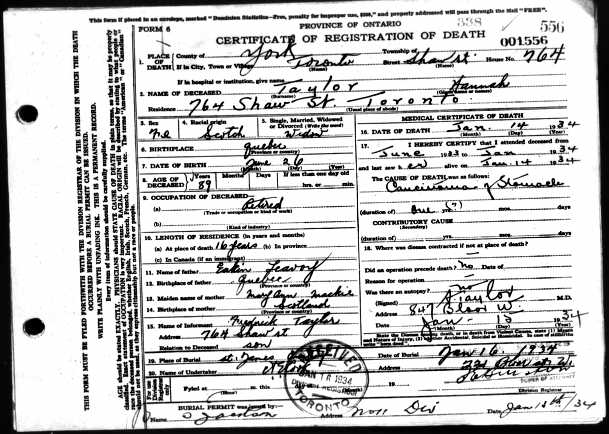
Enos died 2 years later on June 25, 1913 while they still lived at that address. He was 75 years old and appears to have simply passed from his long years of labour.   Hannah lived for many more years, until the age of 89. On January 14, 1934, she died of stomach cancer which she had been treated for by her physician for about a year. Her death record shows that she had been living with her son Frederick at his home for 16 years after the death of her husband, at 764 Shaw st. and he was the informant of her death. She is buried at St. James Cemetery.


What About All Those Other Leavoys?…Nancy Cone

Today, much to my excitement, I noticed two different references to this website on both rootsweb and ancestry.com regarding the Leavoy family. This made me realize that I don’t yet have many postings on the other descendants of Achan Lavoy. I am determined to gather up and tell their stories, but will need the help of other descendants…this is where YOU, yes YOU reading this, decide to drop me a message!

I make note on my page about Achan and Mary Ann that they had six daughters and three sons: Nancy Cone/McGoon, Harriet Kerr, Hanna Taylor, Peter Levoy, Charlotte Parker, Mary Jane Hogg, William Leavoy, Etta Walker, James Edward Lavoy, and Amey Emma Brown. There are so many other Leavoy lines here that have yet to have been described. In this post I have decided to begin the long-winded story of the extended Leavoy family with the first of the children. Below is the beginning of a series of posts on the stories of all those other Leavoys.

The first child in the family was a daughter, Nancy Lavoy. According to census records, she was born on May 1, 1842, likely in McNab township (Arnprior, ON) where her parents were living and where her father farmed. At the time of Nancy’s birth, Arnprior was small and largely deserted. This is because the Scotsman who founded the town, Archibald McNab, lost his settlement rights in 1840. It wasn’t for another 10 years that development really progressed, and this is when large scale lumber operations on the Madawaska fueled the local economy. This means that while the Lavoy family was living hand-to-mouth early on, it was partly a matter of circumstance, based on where they lived. Nancy’s childhood would have been simple at best, and bleak at its worst.

Nancy appears to have been married twice. With the confirmation of Deb Lavoy (see comment below) through email correspondence, I’ve been assured that originally Nancy married to a John McGoon. This first marriage needs documents to fully confirm it, however there are several clues as to when she might have first married. As Deb has pointed out, in the 1871 census (the first that I’ve been able to Locate Nancy and her family in) there is a 5 year difference between the last two children, Hannah (9) and William (4). The eldest child would have been born in 1858, which means that Nancy’s first marriage would have been sometime around that year.  This means that Nancy would have married and had her first child at the tender age of 16.  She would have also been widowed as a 21-year-old. More research is needed on this short lived relationship to verify dates and parentage of Nancy’s first 3 children.

At age 23, Nancy married another American man named William Henry Cone. He was about 10 years her senior, born July 3 1832, and had moved up to Canada in 1839. It wasn’t until 1850 that he became a naturalized citizen of Canada, however, and he had been living and working with his younger brother David in Dalton, Michigan as a lumberman.

It was likely the development of the lumber industry in Arnprior that brought William Henry into town and into the life of Nancy Lavoy. While I have not found their official marriage record, I have traced the couple and their family throughout the 1871, 1881, 1891, 1901 Canadian censuses, observing their story over four decades.

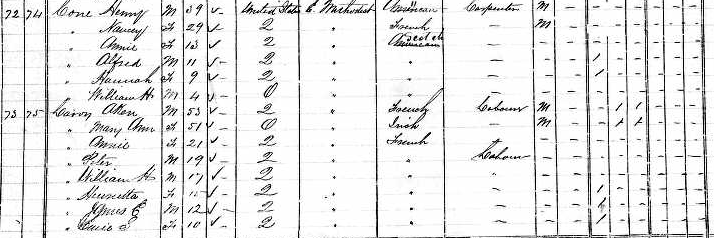
In 1871, William Henry (who went by the name “Henry” at the time), a mature man of 39, worked as a carpenter in McNab township. He and Nancy, lived next door to her parents Achan and Mary Ann and six of her younger siblings. Eventhough Nancy was only 29, the couple already had a family of four children: Annie (13), John Alfred (11), Hannah Olive (9) and William Henry Jr. (4). The ages of these children reveal Nancy’s previous marriage left her with 3 children. Some of Nancy’s siblings who lived next door would have been around the same age as Annie, Alfred, and Hannah Olive Cone, and they likely played together.

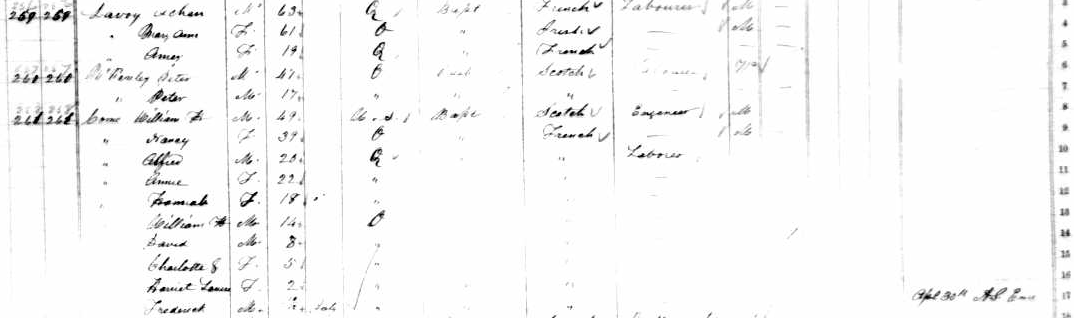
By 1881, all but one of Nancy‘s siblings (the exception is the youngest, Amey) had moved out of her parent’s home two doors down, and her own family had burgeoned to 10 people. Four more children were added to the mix: David Saunders (8), Charlotte “Lottie” Grace (5), Harriet Louisa (2) and baby Frederick (10 months). Annie Cone, who would be 23 years old, no longer lived at home. The eldest, Alfred (20), helped out with the cost of living by working as a labourer, possibly alongside his grandfather Achan.

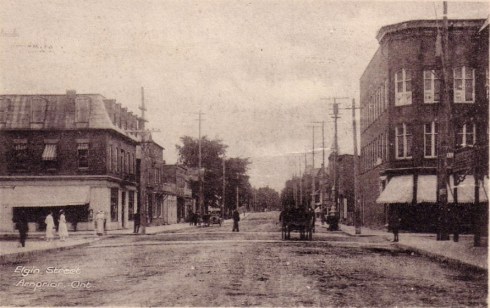
Elgin St., Arnprior 1900.

In the census of 1891, the family is now aged: William Henry is 58 and Nancy is 48. They are living with David Saunders (17) who works as an electrician, Lottie (Charlotte) who is now 15, Louisa (12) and Frederick C., who is 10 years old. The other older children have moved on, as have their grandparents: Alfred married a woman called Emilie Coram, and they and their family settled in Renfrew where he continued to work as an electrician. William Henry Jr. had married a woman called Mabel Louise Thompson from St. Catherines, they had already had 3 sons and were now living in Toronto. Sadly, this year William and Nancy’s daughter Hannah Olive Young died on August 11 of some form of illness. Her husband Alex Young, a blacksmith, reported and signed off on her death.

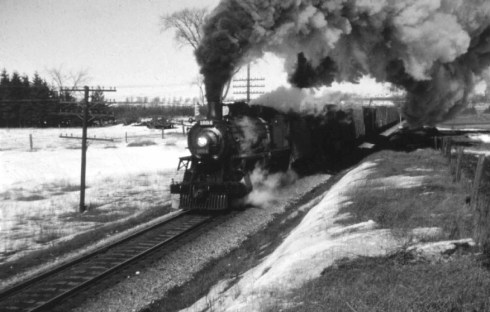
CPR Locomotive, North bay 1900

The last census where I find the Cone family in is that of 1901, where they have moved to Nipissing, North Bay as many other Lavoy family members did. The mining industry overtook the boom of forestry, and the Cone family had a second wind with the introduction of their grandchildren, the Young family, into the home. William Henry, by this time was a senior (68), but still worked as a pumper for Cor W Works (an Iron Works company), earning $640 per year. He and Nancy lived with their son Frederick who was now 20 years old and a machinist by trade. He brought home an additional $600 per year, which would have been helpful in feeding, clothing and schooling grandchildren Frederick (14) , Garnet A. (12) and Lottie Young (9). Also living in Nipissing were two daughters who followed with their new families whom they’d both married 5 years prior:  Charlotte “Lottie”, and Louisa.  Charlotte’s husband George Campbell, worked as a machinist, like his brother-in-law Frederick, to support his wife and three year old daughter. Louisa’s husband, Walter Evans, was a conductor for CN Railways and they lived with their son Milton.

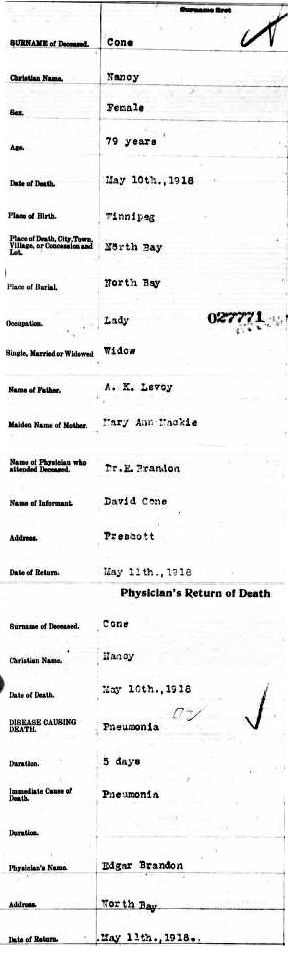
William Henry Cone died at age 77 on March 27, 1908 of dementia. Nancy would have helped to care for him during his 3 month illness. I have found evidence that she lived with her daughter Charlotte and her family in Winnipeg where they moved with George Campbell’s work. Incidentally, Louisa and Walter Evans also lived in Manitoba at the time, so it appears that the family tried where they could to stick together. Frederick Cone stayed in Nipissing and his mother Nancy finally rejoined him sometime before her death in 1918. He married a woman called Norah James 8 years later.


A Big Manilla Envelope From Lindy

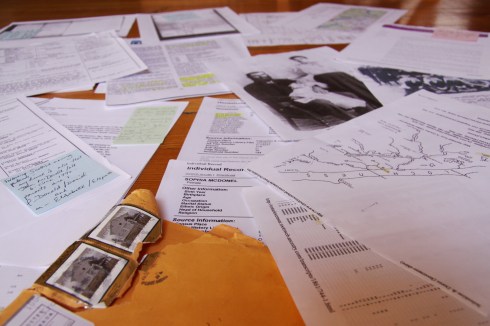
A wonderful woman called Lindy from Cape Breton first contacted me in February of 2008. She had found my information on rootsweb and sent an email to make a point of connection in our research on the McDonnell/Sergeant/Harrower family. Lindy had compiled a whole series of records of the family, from Frontenac and Lanark counties all the way back to Scotland. She was so generous in an email stating “I have PAGES of info for you!!!”. Some people say that and just fall back into the great electronic abyss. Lindy literally sent a whole manilla envelope for me to sort through. This is like coming into an attic treasure (without the cobwebs): although she has marked out different records and maps in blue post-it notes, I still find myself wading through a very deep lake of names, dates and blurry photocopied faces. I took an initial look after she sent the papers to me, but with my emerging career and other obligations in everyday life, this research was put on the back burner. Now that I have decided to actively blog about what I’ve been doing with my spare time over the past decade, I have a reason to splay all of these papers across my dusty wooden floor. I am using this blog to do my initial inventory on this booty.
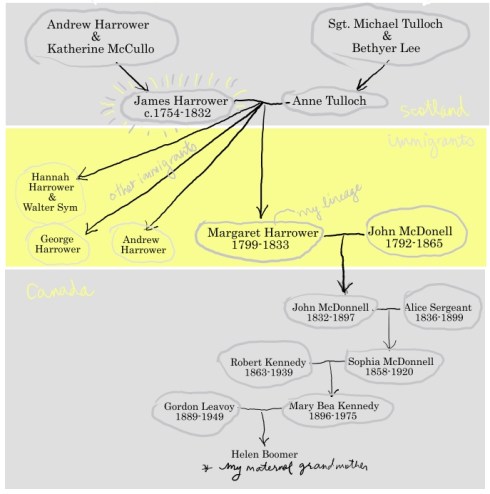
The starting place for this package is a photocopy of an essay called James Harrower, Royal Highlander by Barbara R. Knutsen of Kelowna BC and Barbara & Donald Harrower of Bradenton, Florida (1991). This is a gorgeous read: with familiar language it tells the story of one of the earliest known ancestors in the Harrower family. I was so enthralled at the way this story was told and hope to have the same effect in my own family tales with some practice. To make sense of the people who I am discussing in this blog entry, I would first like to sketch out a rough and basic tree:

The above mentioned essay describes James Harrower who is my 5th great grandfather in my maternal grandmother’s family, the last of the Scottish ancestors in this line who stayed in that country’s highlands. A description of the man reveals that he was a highlander from Crieff, 5’7″, with grey eyes, brown hair and fair skin. He was also a soldier with the British Army who was caught up in that country’s fight against American rebellion during the Revolution. I would like to paraphrase my understanding of the essay here to share all of its meaty bits. This by no means is all that is told, and I recommend that those who are seriously interested get their hands on a copy of the original.

In 1774, as a young man (20 years old), James Harrower entered the 42nd Regiment of Foot, known as “The Royal Highlanders” or “The Black Watch”, which had grown for service overseas. His  involvement took him from Cork to a posting in the reserve British forces for the Battle of Long Island in America, which was the first major battle after the Declaration of Independence.  During this battle, in September of 1776 on York Island, James was wounded on both his right hand and foot. Despite this he remained a member of Captain John McIntosh’s company for another 3 years in the Long Island/New York area.

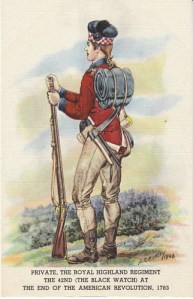
Black Watch private

In 1784, at age 30, James was admitted to the Royal Chelsea Hospital back in Scotland, having been “left lame” from his wound to the foot during his 10 years of military service. He was an outpatient, and was assigned to Garrison duty at Fort Augustus in the rugged Highlands of Scotland, where he helped to “curb the rebellious Scots”. During this year he was promoted from the rank of private to corporal in Capt. Elliot’s Independent Company of Invalids. It is also during this stationing at Fort Augustus that James Harrower married Ann Tulloch, daughter of Sgt. Michael Tulloch in 1786.

James and Ann Harrower had 10 children together who were all baptized at Bolskine parish: Catherine (1787), William (1789), James jr. (1792), Anne jr. (1794), Charles (1797), Margaret (1799), Elizabeth (1801), Hannah (1803), George (1805), Andrew (1807). By 1797 after the birth of their 5th child, James was again promoted, this time to the rank of Sgt., and served another 5 years with The Royal Invalids. His extensive military career continued further, where he later served the 6th Royal Veteran Battalion in Fort Augustus, concluding his posting as paymaster in 1810 when he retired. In all, James Harrower had served in the military for 36.5 years  before he was discharged at Fort George as a man in his mid-fifties. He was given a pension that took him back to his birthplace of Crieff as “beer marching money” (14 days pay of 1 pound, 12 shillings, 8 pence).

Fort Augustus, 1746

In 1818, 8 years after the trek home, his daughter Margaret (my fourth great grandmother) married John McDonnell. That same year, they made the decision to move to Upper Canada to homestead: likely fueled by James’ stories of the new world. They stayed in Glengarry county for several years where they had their first 5 children, and then settled in Lanark where three of her siblings had been granted land.

Three other children of James and Ann soon followed their sister to Canada. The Industrial Revolution brought hard times to Scotland, and the lure of Canada’s wealth of resources beckoned. Many Highlanders were encouraged to move to Lanark County, Ontario, where they were granted 100 acres per family and given seed and farm implements at cost with an advance of money to help them settle the land. Lanark and Dalhousie counties were in fact, as the essay explains, originally Scottish military settlements.Gaelic Book published to promote Scotch immigration

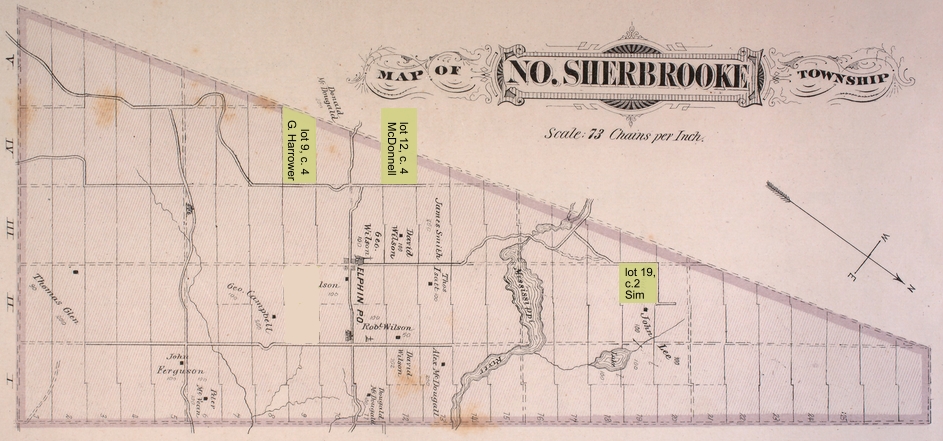
In 1822 Walter Sim, husband to Hannah Harrower, traveled across the sea along with younger her brothers George (17) and Andrew (14). Their trip from Quebec to Montreal by steamship, then from Montreal to La Chine by wagon & foot (10 miles), and onward to Prescott with small flat-bottomed floatillas 120 miles up river, brought them to a meeting place where earlier pioneers met them with wagons.  It was another 74 miles on land from Prescott to Lanark which took an additional 5 days. This difficult journey rewarded them with newly-surveyed crown land that they were assigned to make livable. Walter and George each were given 100 acres at lot 9, concession 4 in North Sherbrooke (Walter, the east half, George, the west) and Andrew shared the lot with his brother, the three of them likely working together to clear the land and construct their log shanty.  Five years later, John McDonnell joined them taking up the east half of lot 12, concession 4. Later he received two more lots in Palmerston.

The last of the Harrower family to arrive in Canada, Walter’s wife Hannah, came from Scotland accompanied by Walter and their children in 1832. Walter had gone back to fetch her nine years earlier, but her father, the great James Harrower who was described earlier, was ill and she would not leave him alone. His wife and other children seemed no longer in existence, so they waited until conditions were more favourable to make the long trip.  James, however, died the night before they left at age 79. While Walter was away, George had worked his half of the lot and had petitioned for it to be made his. This caused a bit of a family rift where Walter, who complained that this was not done with his consent, was forced to take up another property- lot 19, concession 2.North Sherbrooke properties

Later, in 1833, all 4 Harrower children (Margaret McDonnell, Hannah Sim, George and Andrew Harrower) attempted to appeal to the government that their land be granted to them for free because of their father’s service to the British Army during the Revolution. Because he was not living in America prior to his war service (as he came over from Scotland), he could not technically qualify as a United Empire Loyalist. They were not granted their claim. Despite this, they all stayed in the region: Andrew in Warwick county with his wife Sarah Williamson, their many children, and a child from his first wife Betsey Stokes; George in Lambton with his wife Eliza Williamson and their 8 children (they are buried in the pioneer cemetery); Walter and Hannah Sim stayed in North Sherbroke with their 8 children and were joined by Walter’s brother Robert (they’re buried in Crawford Cemetery); and my ancestors Margaret and John McDonnell also maintained their lots in North Sherbrooke & Palmerston with many many children.

This essay came with a large family tree which mapped out many of the known descendants- quite a tangled web. Many other documents were included in Lindy‘s package which attempt to further flesh out this Harrower-McDonnell connection. It is difficult to trace John McDonnell‘s life in Scotland, but Lindy believes that we can follow Scotch naming traditions and make an educated guess that his parents may have been called Donald/Daniel and Elizabeth/Elspeth. Their first son, James, was named for Margaret‘s father James Harrower, so their second son, Donald was likely named for his paternal grandfather. Elizabeth, their first daughter could have likely been named for her paternal grandmother, as their second daughter, Ann had been named for Margaret’s mother Ann Tulloch. This tradition was followed with other children, so this may be a starting point for searching out Scottish records for John’s family. Some hints to the McDonnell mystery may also lie in his early Canadian life in Glengarry county where there were many McDonnells. There is a family story that John had a brother named Hugh who came over to Canada in 1820, and would have likely settled in Glengarry. Lindy also sent a copy of a letter that one of the previously mentioned authors, Barbara Knudsen, wrote to St. Benedict’s Abbey in Fort Augustus. She looked into where John and Margaret married in Scotland, seeking out church records trying to determine if this Abbey may have been the place. Unfortunately, the priest’s register of their time has not survived. The current priest did affirm Barbara’s belief that John was a Glengarry Catholic because they spelled their name with an “ell” at the end as opposed to “MacDonald”.

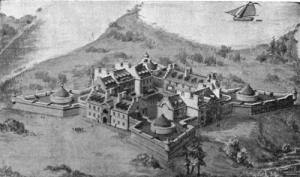
St Benedictine Abbey, Fort Augustus

Other documents included in this package number maps of the Lanark county properties owned by the Harrower-McDonnell-Sim families, maps of Invernesshire, Scotland, photographs of some Harrower descendants, documents transferring property and further family data…too much to outline here. I will continue to sift through this fascinating history and add more to this story in the future.


The Kennedys Who Went To Wisconsin

image courtesy of yejorgens (ancestry.com)

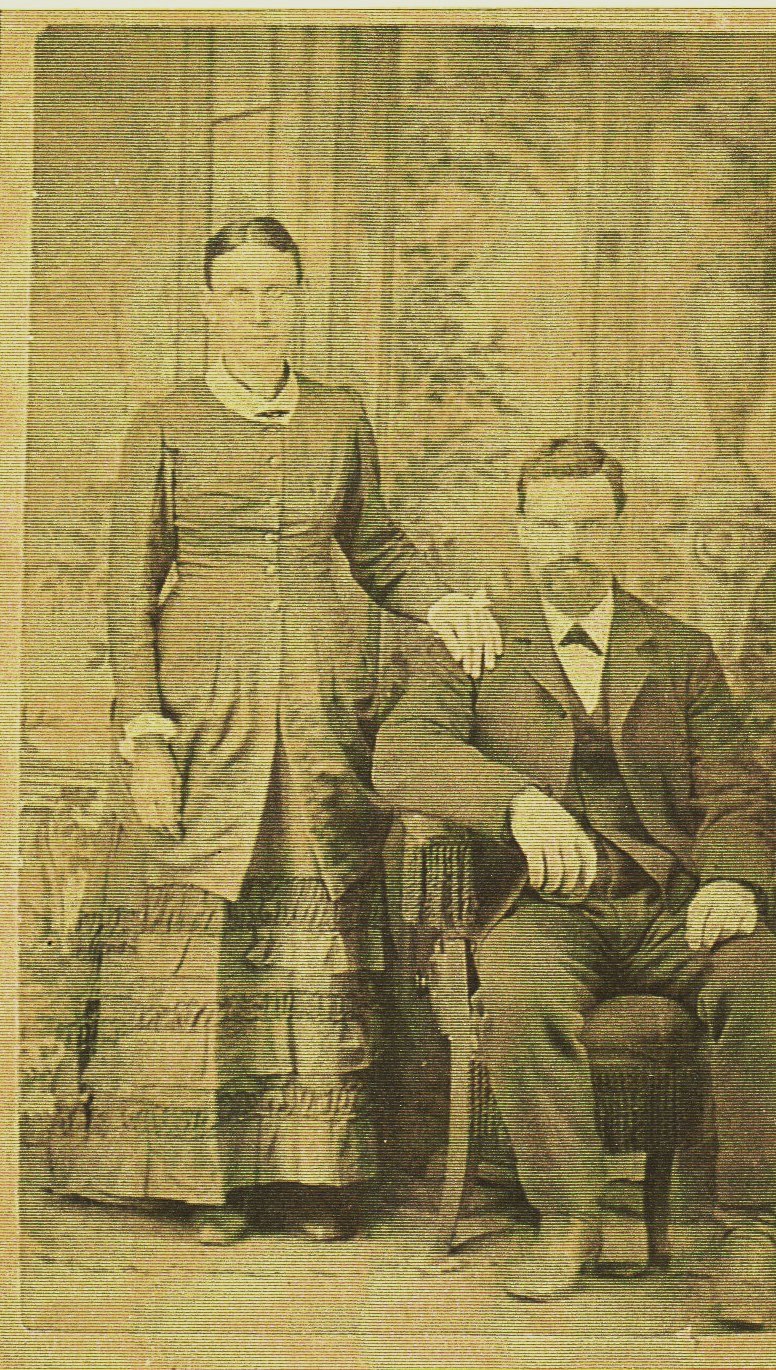
William James Kennedy and Emily Moore

I’ve recently met Don, from Milwaukee WI, who is doing research for his granddaughter: a descendant of William Kennedy Jr. who was an older brother to my great x 2 grandfather Robert Kennedy. Like many of us who are researching our ancestry, it appears that his drive is to understand the stories of past family members as a gift of story for the next generation. I find myself compiling this website with my own niece in mind. She’ll be turning 1 year old this year and soon enough she will be ready for all of the stories I can tell her about her foundations here in Canada… at least on my side of the family. Don seems to be more ambitious as the Kennedy family is not his own side of the family.  He has put great effort into uncovering the story of William and Emily by contacting the Wisconsin Historical Society for records and collecting photographs of the family descendants. Many beautiful photographs of the Kennedys and their family reunion have also been collected and made public by another descendant of William and James (their great granddaughter) named Yvonne. She and Don have been in contact and through their combined efforts I am able to do my part in compiling this into a narrative into the blog entry below. Out of respect for a descendant who does not wish records found by Don to be posted, I am not including images of these documents. Suffice to say that there are records to back up this narrative. Not only does William & Emily‘s story allow us a better glimpse into our Kennedy clan, but it also pieces together the American and Canadian sides of the family.

Fallowfield churches circa 1910

William James Kennedy was the second child of 16 belonging to farmers William Kennedy & Mary Bridgen. He was baptized in Fallowfield, Ontario, sometime between 1851-1968, and Canadian census dates place his birth date as 23 February, 1851 in Tichborne, Ontario. I gasp when I read the record of his baptism, as it brings the Kennedy ancestors so close to me. While I wasn’t born in Fallowfield, I spent much of my childhood and teenage years living next door, in Kanata, and the name recalls so much for me as I currently live across the country from there.

According to his newspaper obituary, at age 17 (1868) he moved to Wingville township, in the Southwestern corner of the state of Wisconsin and bought land in the village of Montfort. I am unsure what his motivation was to move across the border and leave his family back in Ontario. From all of my research on this family, this question lingers. Two other siblings seem to have moved south also,but not together. The southern part of Wisconsin originally attracted people to mine the land, as it was particularly rich in minerals (especially lead and zinc). However, it soon became apparent that wheat farming was more viable longterm with Grant county’s rich soil, and as William came from a farming family and planned to continue living off the land, this might have been the attractor for him. He likely came to Wisconsin via train which was rapidly being built in WI between 1870 and 1900.

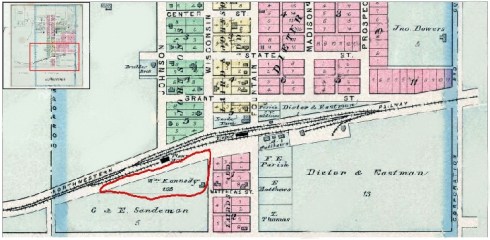
Montfort is the place where he met his future wife, a woman named Emily Jane Moore (1848-1927), daughter of John & Elizabeth. Emily was born in the nearby town of Benton. She and William were married two years after his arrival in Wisconsin, on the 9th of December 1871 in Montford. The wedding was witnessed by George Stevens and Sophia Laird who were both from town. The couple stayed in Montfort, settling on a property at the edge of town next to the flour mill and the train depot (see map below). In 1880, construction on the new Chicago and Tomah line began, linking with Madison by way of the junction next to William’s land. He would have been expected to donate land to the building of these tracks. The railroad also asked the communities along the line to invest money in the railroad in exchange for the building and maintenance of railway depots. By October of 1882, a passenger train left Montfort daily (except Sundays) midmorning, and arrived from its origins in Milwaukee by supper time. There were also one freight and one mixed train that traveled each way, making this location a bustling space of travelers.

I've circled William's property in red

William decided to become a stonemason at some point after moving to Montfort. The income he earned in his profession had to support his and Emily‘s large family of 13 children, 3 of whom died very young (Dora Melissa Kennedy 1879-80, David Walter Kennedy1881-86, and Flossie Kennedy 1896 who died at birth). The ones who survived into adulthood are as follows:

Ina Florence Kennedy (1872-1942) married and became a Womack;  Emily Frances Kennedy(1874-1955), married an Irish immigrant named John T. O’Brien, and raised their family in Montfort; William John Kennedy (1876-1924) worked as a day laborer and farmed while living with the family; Mary Jane “Minnie” Kennedy (1877-1956), married John P. Crawley in 1896 and moved about within the state, then to Philadelphia, before coming back to Wisconsin later in life. She and her husband had 7 children together. There was Effie Phyllis Kennedy (1884-1972), who married to a man named Charles Guilford; Alta Ann Kennedy (1886-1950), who worked in a hotel while living at home, and then lived in Platteville later on; Wallace Oscar Kennedy (1888-1972) mined lead as a young man in the area to help earn his keep, and later became a butcher by trade. He married a woman called Edith Martha Fischer in Antigo and had a daughter. Another son, Elmer Thomas Kennedy (1890-1967), stayed in Wisconsin, and married a woman named Blanche Moore in Illinois. They had five children. Richard Earl Kennedy (1891-1949), stayed in Montfort where he had a farm. He married Dora Markwardt and they had four children together. Isa Irma Kennedy (1898-1969) who became a teacher and supported her widowed mother in her twenties and then married August Schumann. She had a daughter.

William & Eliza Kennedy's children, courtesy of bigdm50 on ancestry.com

This photograph is believed to be taken at Emily Kennedy's funeral (1927). Individuals pictured are all (except one) children of William and Emily. Back row (L-R): Charley Hill (half brother of Emily), Wallace Kennedy, Isa Schuman, Earl Kennedy, Emily Frances O'Brien, and Elmer Kennedy. Front (L-R): Minnie Crawley, Effie Gulliford, Ina Womack and Alta Schumann.

William clearly had a good reputation within Montfort, because his obituary describes him as such:

Since coming to Wisconsin he has resided in Montfort, and is well and favorably known and highly respected by all. His entire life was characterized by honesty and uprightness, and the community suffers the loss of one of its most worthy citizens in the fall of this good man.

He died of acute indigestion during a visit to his daughter’s home on June 13th, 1912 and was buried in the Montfort cemetery just outside of town. After his death, his wife Emily continued to live with her children as can be seen in the census of 1920. She died in Montfort at the age of 79, in 1927. There are many descendants of William and Emily and several are researching their families. Below is a photograph from their first Kennedy reunion.

Photograph courtesy of yejorgens on ancestry.com

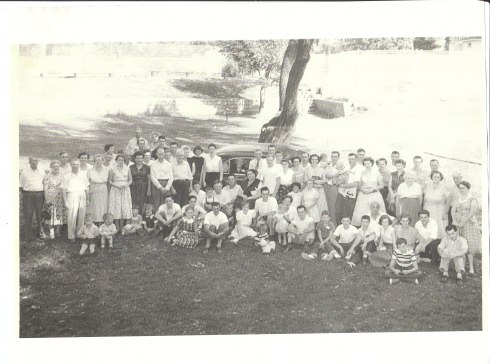
Family reunion of descendants of William and Emily Kennedy (1955)