
William Henry Leavoy. Photo courtesy of Jim Smith.
There is much information collected on William, the second son of Achan and Mary. In fact, before I ever really uncovered the story of his brother Peter, who is my great x 2 grandfather, I found stories, census records and family members all talking about William. This is largely due to the fact that he was written about extensively by his grandson, Wilfred Ronald Leavoy in an autobiography, and consequently this is where much of the meat of my story is gathered from. To read from this primary source beyond the quotes I give, click here. The research that informs this story is largely census-based, and is supplemented by family stories and photographs submitted by readers of this blog. A big thank you to these other Leavoys!
William’s story begins on September 5, 1854. The seventh child and middle son of the family seemed to be well received and was considered by others as “handsome[…] a noted singer, dancer and river dancer.”(Robin Murphy) These characterizations come from his years as a young man, but even as a child he was special. It is claimed by his grandson that he was the first white boy to be born in the village of Pontiac, Quebec.
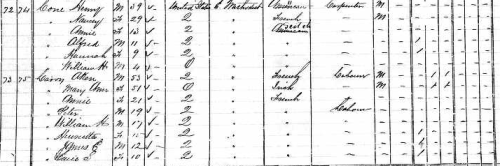
At age 17, the 1871 census of Canada has captured a picture of William’s youth and what it might have been like. In the McNab district of South Renfrew, the family of seven children lived with parents “Aken” and Mary, and sister Mary Jane‘s husband with their 2-month-old baby, Mary Ann. This was a multi-generational home built on lumbering in the dark months and farming in the summer. Peter, two years William’s senior, is listed as a labourer, but William neither attends school or works…at least not on paper. Yet we know from family stories that William followed his father in the logging camps and was likely out in the bush as soon as he could drive horses and had left school. His grandson has noted that “[h]is family had very little schooling, with a large family on a farm; they had to dig in to help feed the rest.” This means that all of the boys in particular would have entered the workforce early. He would have worked hard, indeed, moving up in the ranks with his talent and brawn so that as a young man he was in some position of authority. W. R. Leavoy described it thus:
[m]y Grandfather followed the logging and as a young man became a foreman which meant you were like a Captain on a ship. When you went into the woods in the fall you took your men, horses and supplies to last five months and in most cases when the snow got deep you were pretty well isolated. You had to be able to lick any man in the camp as you couldn’t call the cops. There were none. No phones and no radio either. You were there till the ice went out then the men drove the logs down the rivers to the sawmills. It was a terrible job, wet and cold and quite a few graves lined the river banks as the logs would get caught and pile up in the narrow places along the river. Then you have a logjam. They would have to pry the key logs out and sometimes the whole thing would let go suddenly, crippling some and drowning some.
From this character-filled story we can see that the Leavoy boys, William included, needed to be smart working in these dangerous conditions.
I have found William at age 25 on a voters list living further south along Lake Ontario, in Colbourne. He would have been married at this time and trying to make a fresh life of his own. The voter’s list gives his place of residence as Lot 6 concession 5. But by age 26, only a year later, William was already a widower. His little recorded first marriage to a woman named Janet McWhirter ended with her premature death at age 25. She was buried in the Carlow United Church cemetery with her family. One Leavoy family member has noted that this couple had 2 children together: Eva Maude Leavoy (born April 8, 1883) and Mary Anne Leavoy (born 23 July 1884). If you have more information on this first marriage, do comment at the end of this blog entry!

Janet Hamilton Hynes. Photo courtesy of Jim Smith.
His second marriage came a year later, to Janet Hamilton Hynes (24), daughter of another farming couple, William and Ellen (Tefler) Hines. On his marriage certificate he is listed as a widower, confirming that his first wife, Janet McWhirter, had in fact died. His parents are listed as “Stephen” (another curious spelling!) and Mary Ann. The witnesses were Thomas & Jessie Stewart were of the nearby prominent Stewart family and may have been relations to sister-in-law Agnes (Stewart) Lavoy.
This couple had fourteen children together between 1883 and 1908. The first two children died as infants (the 12 surviving children were: William A., Teresa, Ellen J., James H., Geneve, Ernest W., Wilfred Garnet, Hannah, Abbott Raymond, Iva E., Kenneth P., Maurice) and one can imagine that the first few years of their marriage would have been difficult in light of this. It isn’t surprising to see that the couple was documented as being particularly religious on the following census.
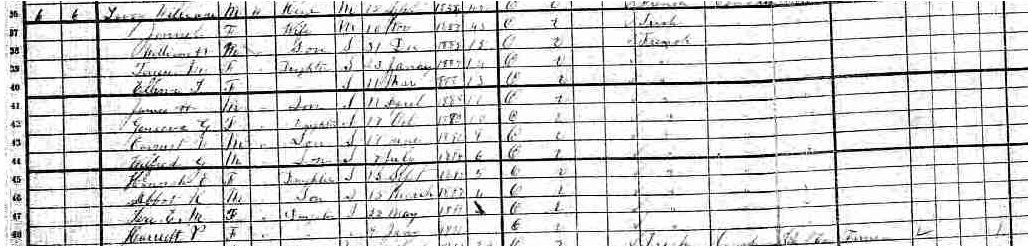
 The first census document to list William and his second marriage is that of 1891. Living on a farm in Hastings North, they have five children and subscribe to the religion Plymouth Brethren, a conservative evangelical Christian movement of their time. Children William Henry Jr. (born December 31, 1885), Tressa Mabel (born 23 February 1887), Elleanor “Ellie” Irene (born 11 March 1888), James Herbert (born 11 April 1889) and Genevieve Gertrude (born 17 October 1890) would have been supported by their father’s farming and would be raised in a community of farmers from all kinds of European countries.
Ten years later the Leavoy clan still resided in the North Hastings area, but had grown considerably as would be expected of a farming family. The couple now lived with their eleven children ranging from infancy to mid teens. Eldest son, William jr.(15) attends school for 4 months a year, and likely helped his father, uncle James and grandfather Achan who were now all neighbours. Teresa (14) and Ellen (13) also attend school for 4 months. Younger brother James (11) only attends for 1 month and Genevieve (10) doesn’t go at all.
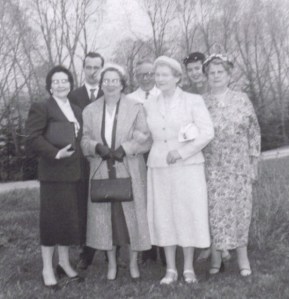
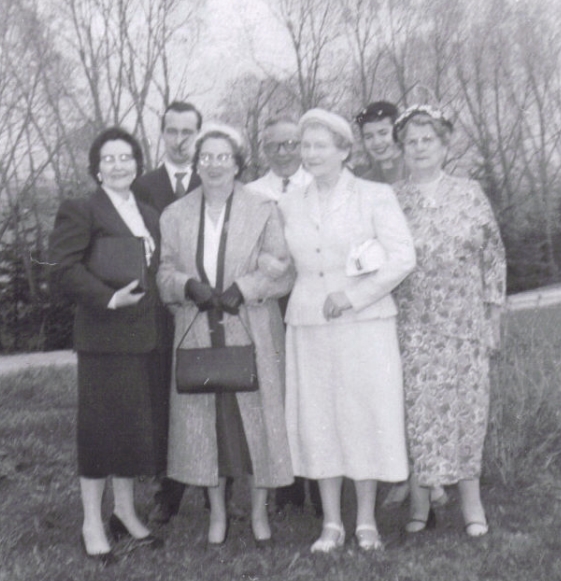
The Leavoy sisters in 1956. In the front row are (left-right): Pearl (Leavoy) Hazlett, Iva (Leavoy) Burwash, Tressa (Leavoy) Gates, Ellie (Leavoy) Henderson. Photo courtesy of Garnet Leavoy.
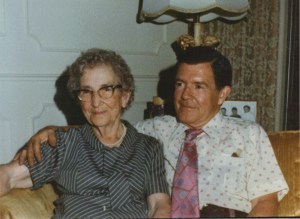
Hanna (Leavoy) Price and son, Norman. Photo courtesy of Garnet Leavoy.
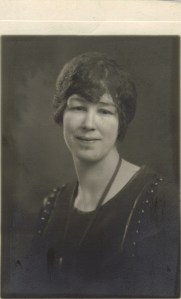
Daughter Genevieve Gertrude Leavoy. Photo courtesy of Garnet Leavoy.
Added to their roost are children: Ernest Wellington (born 17 June 1892), Wilfred Garnet (born 9 July 1894), Hannah Effie (born 15 September 1895), Edward/Abbott Raymond ( born 1 March 1897), Iva Emily (born 22 May 1899) and Harriet “Pearl”. (born 9 July 1901). The last child to be born to the couple, who had not yet arrived, was a son called Maurice Reynold (born 10 February, 1908).
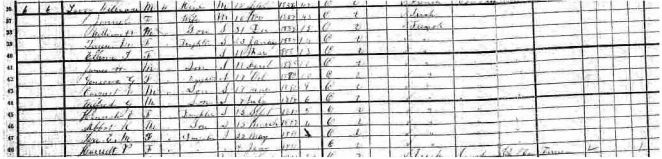 In 1911, William and Jannet were recorded in south Renfrew with the spelling of their last name as Lavoi. William’s father Achan died in 1902, signalling a change in living arrangements: they were no longer neighbours. In their 50s, they still supported a family with young children, but now had one of their eldest daughters and their son in law living with them. Their children Wellington (this is “Ernest W.” from the previous census, now 18) and Garnet (“Wilfred” from the previous census, now 16) both worked on their family farm at Lot 5. Daughters Hannah (15), Edith (Iva from the previous census), Pearl and Maurice all still live at home. The dates given for their births in this census conflict with those of the census 10 years prior, making their exact ages difficult to decipher. Another change that this document gives evidence of is the marriage of their second daughter “Ella” or Ellen (age 22). She and her husband John Henderson (25), moved in with the Lavoy family, likely giving help with expenses as John works as a machinist in nearby Coxandum mine, earning $750 in a year.
Cross-referencing this census information with the autobiography of William’s grandson gives further insight into these living arrangements. He notes that two years prior to this census date, gold had been discovered in nearby Porcupine Creek and heavily forested and rough farm land was being offered in the Mattheson area for a cheap price of 50 cents per acre. Interestingly, Mattheson has since been known for its gold. The Lavoy family moved into the area, scooping up four farms: one for William Sr., William Jr. and his new wife Annie Mae (McPherson), one for son Raymond, and another for Ella and John Henderson. They settled in the area along the railroad in Mattheson in 1913, according to W.R. Leavoy. Unfortunately, in 1916, much of the town burned down and William Jr.’s two homes were lost in the great fire.
After this census, none other are publicly available. We are lucky, however to have family members willing to share photos, details and stories of their own. We also have a great storyteller in the family who has written from personal experience, Wilfred Ronald Leavoy, a man whose story is worth reading for those who are interested in the greater details of this family’s story.
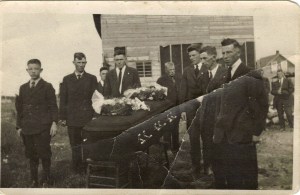
Janet (Hamilton) Leavoy funeral, July 6, 1922. Pictured in this image are the following (left-right): sons Maurice, William H. jr. and Wellington, husband William Henry Leavoy Sr., sons Raymond H. and Garnet. Photo courtesy of Garnet Leavoy.
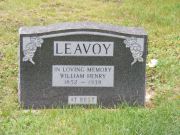
photograph courtesy of Garnet Leavoy
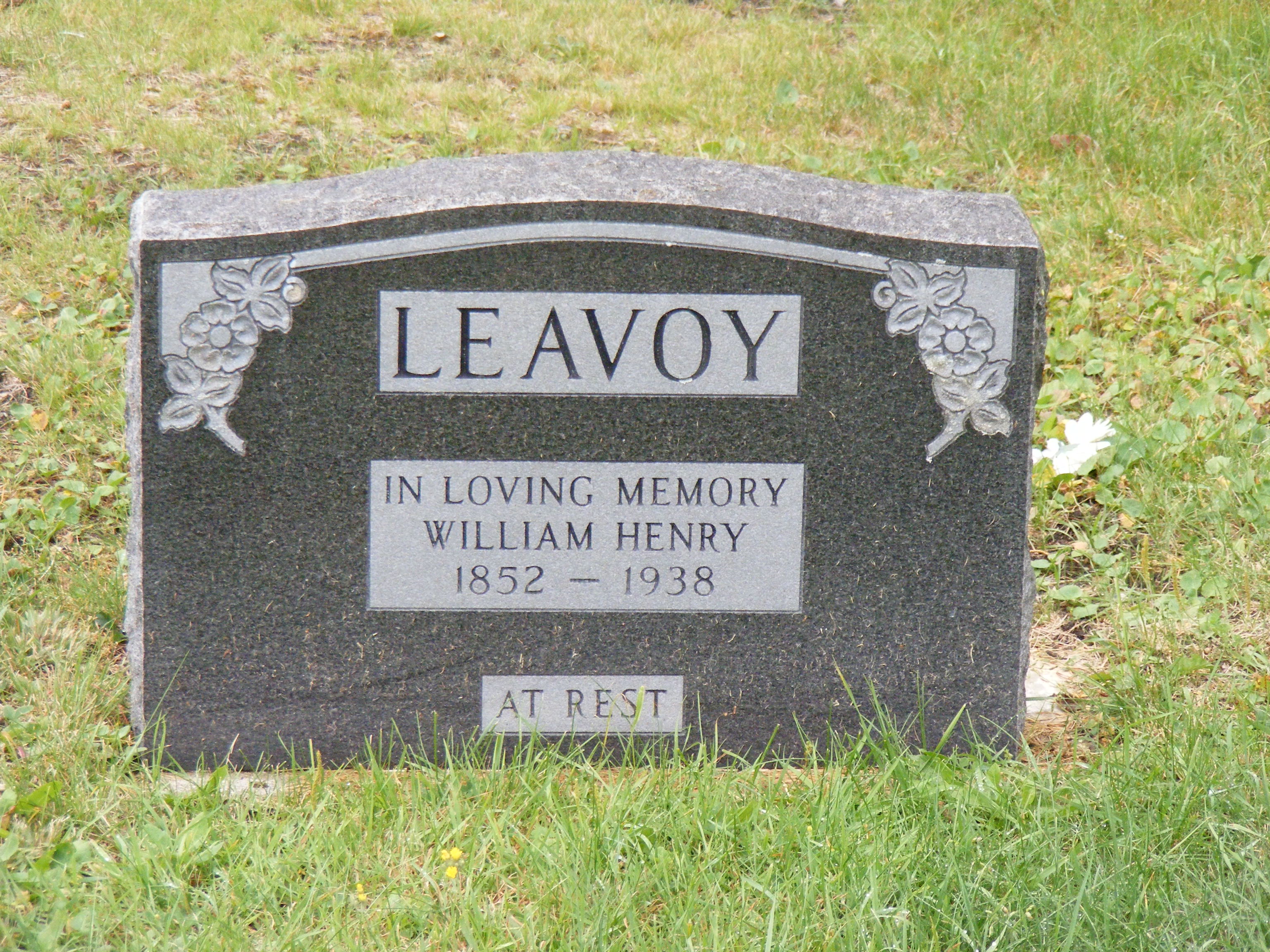
Suffice to say that in 1922 William’s wife Jannet died and he later followed in 1938, after continuing to farm with the help of his grandchildren. This family, as many of the others in the Leavoy clan, had a great impact on the Canadian landscape. They participated in the ‘taming of the land’ from Quebec to Lake Ontario and left their mark in the farm fields, forests and mines. The couple is buried in Carlow cemetery, in the Ottawa valley, Ontario (Canada).











 Oh What a Tree